
Bankroll Management in Football Betting for Long Term Survival
A complete guide to bankroll management in football betting, covering staking strategies, variance, risk control, and long-term profitability.
In this article
- What bankroll management really means
- Why poor staking destroys good football predictions
- Flat staking or percentage staking
- Choosing the right unit size for your bankroll
- How variance shapes your results
- How different odds ranges change bankroll pressure
- Should you increase stakes on stronger football bets
- The bankroll mistakes that ruin good betting
- Tracking results to protect long-term bankroll health
- Building a practical bankroll management system
Bankroll management in football betting is not about squeezing the biggest possible return out of every weekend. It is about controlling risk, surviving variance, and staying consistent long enough for a real edge to matter.
Even accurate match analysis becomes irrelevant without disciplined staking. A bettor can identify value correctly and still lose money because the bankroll structure is poor.
Profitability in football betting depends as much on stake control as it does on prediction accuracy.
Bankroll work makes the most sense when you pair it with football betting strategy, value betting football, and the live football betting simulator. That combination lets you connect stake sizing to edge quality instead of treating bankroll control as a separate topic.
Start here
Football Betting Strategy for Smarter Long Term Decisions
This guide sits inside a wider topic path. Read the core concept first if you want the parent framework before the deeper market detail.
Read the core conceptWhat bankroll management really means
Bankroll management refers to how a bettor allocates capital across bets while controlling total risk exposure.
At its core, it separates betting capital from personal finances and applies a structured staking method.
Key components of a bankroll
| Component | Description | Betting Impact |
|---|---|---|
| Total bankroll | Dedicated betting funds | Defines risk capacity |
| Unit size | Standard stake per bet | Controls volatility |
| Stake strategy | Flat or variable | Affects growth versus risk |
| Risk per bet | Percent of bankroll per wager | Determines drawdown speed |
A well-defined bankroll ensures that:
- Losing streaks do not wipe out capital.
- Stakes remain consistent regardless of emotion.
- Performance can be measured objectively.
Core principles
- Separate bankroll from daily finances.
- Use predefined stake sizes.
- Avoid adjusting stakes impulsively.
- Think in long-term cycles, not individual bets.
Structured systems treat bankroll as part of the strategy itself, not as something to think about after the picks are made.
Why poor staking destroys good football predictions
A common misconception in football betting is that prediction accuracy alone determines profitability. In reality, staking errors can wipe out even strong analytical edges.
A bettor can have a positive expected value and still lose money if stake sizing is inconsistent or too aggressive.
The mismatch between prediction quality and staking
| Scenario | Prediction Accuracy | Staking Strategy | Outcome |
|---|---|---|---|
| Disciplined bettor | Moderate 55 to 58 percent | Consistent units | Stable growth |
| Aggressive bettor | Good 60 percent plus | Variable or chasing | High volatility and losses |
| Emotional bettor | Inconsistent | Random stakes | Bankroll depletion |
| Overconfident bettor | Good short-term | Increasing stakes | Collapse after variance |
The table shows that staking discipline often matters as much as raw prediction skill.
Key mechanisms that cause failure
Overbetting during perceived strong picks
Increasing stakes without a quantified edge leads to disproportionate losses.
Chasing losses
Attempting to recover quickly increases exposure during statistically normal downturns.
Inconsistent unit sizing
This breaks the ability to evaluate performance and introduces randomness.
Ignoring variance
Even profitable strategies experience losing streaks, and poor staking accelerates bankroll decline.
Example of staking impact
Assume two bettors with identical predictions:
- Both place 100 bets at a 55 percent win rate.
- Average odds are 1.90.
Bettor A, who is disciplined:
- Uses 1 unit per bet.
- Experiences manageable drawdowns.
- Ends with small but consistent profit.
Bettor B, who is undisciplined:
- Stakes vary between 1 and 5 units.
- Hits the same results but suffers large swings.
- Is more likely to end negative because variance gets amplified.
What this really shows
- Profitability equals edge multiplied by discipline.
- Without controlled staking, edge cannot materialize.
- Bankroll destruction usually comes from how much is bet, not what is bet.
TipSignal next step
Stress-test the bankroll logic
Use the simulator to see how staking, variance, and odds range decisions affect bankroll paths over time.
Test bankroll scenarios in the simulatorFlat staking or percentage staking
The choice between flat staking and percentage staking defines how a bankroll behaves under pressure. Each method has different implications for risk control, growth rate, and psychological stability.
Core comparison of staking models
| Staking Model | Description | Risk Level | Stability | Growth Potential |
|---|---|---|---|---|
| Flat staking | Same unit per bet | Low | High | Moderate |
| Percentage staking | Percent of current bankroll per bet | Medium | Medium | Adaptive |
| Variable staking | Stake based on confidence | High | Low | Unstable |
Flat and percentage staking are the only two consistently viable long-term approaches. Variable staking introduces subjectivity, which often leads to overexposure.
Flat staking works through consistency
Flat staking means risking the same amount on every bet regardless of odds or perceived edge.
Advantages:
- Predictable drawdowns.
- Easier performance tracking.
- Lower emotional influence.
Limitations:
- It does not scale with bankroll growth.
- It can underuse stronger edges if they are genuinely measurable.
Percentage staking works through adjustment
Percentage staking adjusts stake size based on bankroll fluctuations.
Example:
- Bankroll of €1,000.
- Stake of 2 percent equals €20.
- After growth to €1,200, the same stake becomes €24.
Advantages:
- Protects bankroll during losing streaks.
- Automatically compounds during winning periods.
Risks:
- Drawdowns can still feel larger during volatile periods.
- It requires strict discipline to maintain percentage consistency.
When each approach works best
Flat staking is more suitable when:
- Prediction edge is uncertain.
- Stability is the main priority.
- Record keeping is a focus.
Percentage staking is more suitable when:
- Edge is measurable and consistent.
- Moderate volatility is acceptable.
- Long-term growth matters more than smoothness.
What matters most here
Football markets are relatively efficient, which means edges are often small. Because of that:
- Flat staking reduces the risk of overestimating edge.
- Percentage staking should usually stay conservative, often in the 1 to 3 percent range.
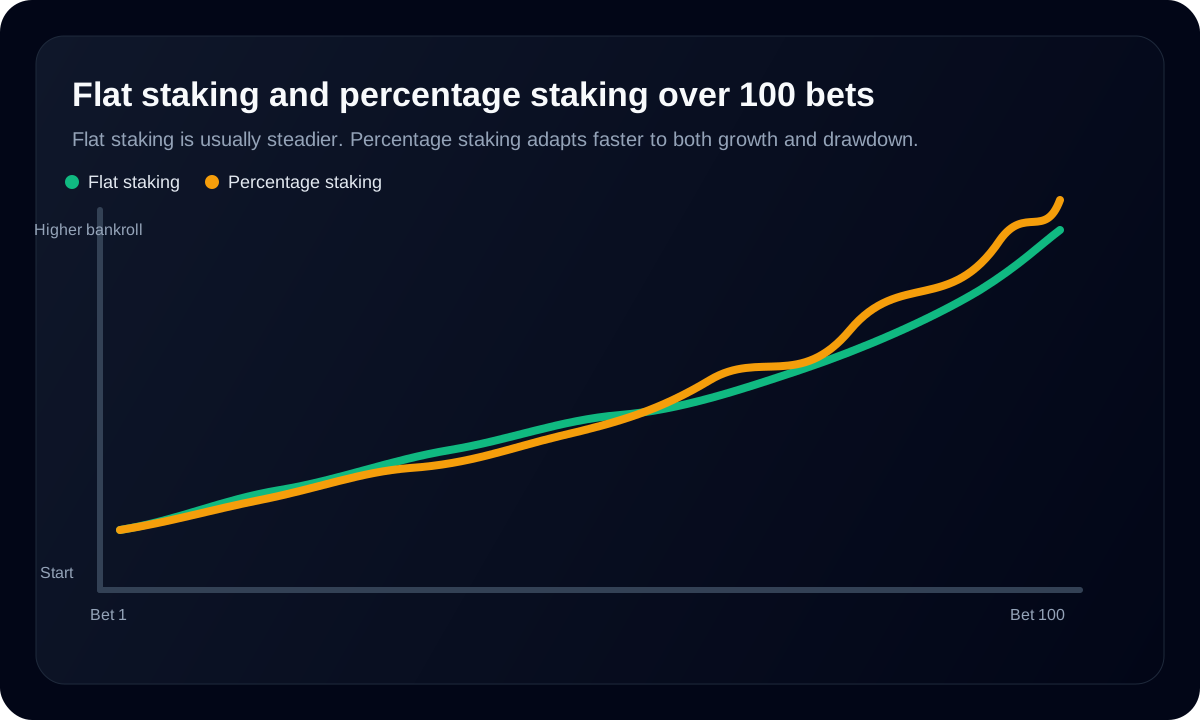 Flat staking usually produces a steadier bankroll curve, while percentage staking adapts more aggressively to both growth and drawdown over a 100-bet sample.
Choosing the right unit size for your bankroll
Unit sizing is one of the most important decisions in bankroll management for football betting. It determines how much of your capital is exposed on each bet and directly affects drawdowns, recovery ability, and long-term sustainability.
A unit is not just a number. It is a risk-control mechanism.
Typical unit size ranges
| Bankroll Size | Conservative 1% | Moderate 2% | Aggressive 3 to 5% |
|---|---|---|---|
| €500 | €5 | €10 | €15 to €25 |
| €1,000 | €10 | €20 | €30 to €50 |
| €2,000 | €20 | €40 | €60 to €100 |
| €5,000 | €50 | €100 | €150 to €250 |
This table highlights a key principle. Unit size should always scale relative to bankroll, not confidence.
Why unit size matters more than most bettors think
Incorrect unit sizing creates two major problems.
Overexposure during losing runs
Larger units accelerate drawdowns beyond recovery range.
Inconsistent performance evaluation
Without fixed units, it becomes difficult to assess ROI and edge.
Even a small difference such as 2 percent versus 4 percent can double volatility.
Key factors when selecting unit size
- Bankroll size. Smaller bankrolls require stricter risk control.
- Bet frequency. Higher volume usually means smaller units.
- Odds profile. Higher odds increase variance, so lower units are usually safer.
- Edge certainty. Uncertain edges demand conservative sizing.
Practical unit sizing framework
- Beginners often do best with 1 percent per bet.
- Intermediate bettors usually fit in the 1.5 to 2 percent range.
- Advanced or data-driven bettors should still cap exposure around 2 to 3 percent.
What to remember
- Unit size defines risk, not confidence.
- Smaller units improve long-term survival probability.
- Consistency matters more than optimization.
- Most bankroll failures come from units that are too large, not too small.
How variance shapes your results
Variance is an unavoidable part of football betting. Even with a profitable strategy, short-term results can deviate sharply from expectations. Understanding variance is essential for setting realistic expectations and protecting your bankroll.
Expected and actual outcomes
| Metric | Expected Long Term | Short-Term Reality |
|---|---|---|
| Win rate at odds 1.90 | Around 52.6 percent break-even | Swings between 45 and 60 percent |
| 100-bet sequence | Small profit or loss | Large variance possible |
| Losing streaks | 5 to 8 bets typical | 10 or more possible |
| ROI | More stable over time | Highly volatile short term |
The key point is simple. Short-term results are unreliable indicators of strategy quality.
Why variance is higher in football betting
- Football is low-scoring, so small moments decide matches.
- Market edges are often minimal.
- External events such as red cards and penalties change outcomes quickly.
- Draw frequency increases unpredictability.
Typical variance patterns bettors should expect
- A bettor with a 55 percent win rate can still lose 8 to 12 bets in a row.
- Profitable months can be followed by losing months.
- ROI stabilizes only over a large sample, often 300 bets or more.
Practical implications for bankroll management
- Unit size should account for worst-case losing streaks.
- The bankroll should be able to absorb 30 to 50 bets without panic adjustments.
- Strategy changes should not be driven by short-term outcomes.
What variance means in practice
- Variance is not a flaw. It is part of the system.
- Emotional reactions to variance usually make results worse.
- Stability comes from consistent staking, not prediction certainty.
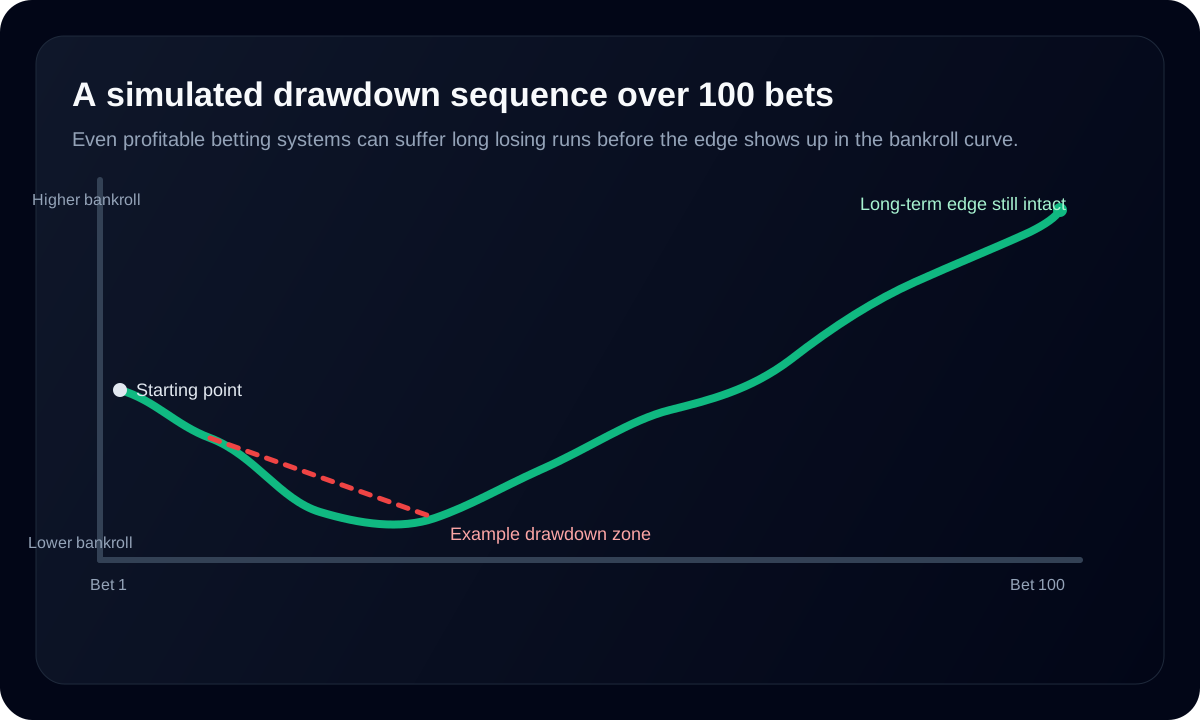 A simulated 100-bet bankroll path showing how normal losing streaks and drawdowns can still appear inside a profitable long-term strategy.
How different odds ranges change bankroll pressure
Not all bets affect your bankroll the same way. Odds range plays a major role in drawdown patterns, variance, and sensible stake sizing.
A bettor who mostly backs prices around 1.50 will experience a very different bankroll path from someone targeting 3.00 and above, even if both strategies are profitable long term.
How odds affect bankroll behaviour
| Odds Range | Implied Probability | Win Rate Needed | Variance Level | Typical Drawdowns |
|---|---|---|---|---|
| 1.30 to 1.60 | 62 to 77 percent | High | Low | Short losing runs |
| 1.70 to 2.10 | 48 to 59 percent | Moderate | Medium | Balanced swings |
| 2.20 to 3.50 | 28 to 45 percent | Lower | High | Long losing streaks |
| 4.00 plus | Below 25 percent | Low | Very high | Extreme volatility |
The key insight is that higher odds reduce win rate and increase variance even when expected value remains positive.
Strategic implications for bankroll management
- Lower odds allow slightly larger unit sizes because of greater stability.
- Medium odds usually need balanced staking.
- High odds demand smaller stakes because losing sequences are longer.
Adapting staking by odds profile
A structured approach might look like this:
- 1.30 to 1.60 at 1.5 to 2 percent per bet.
- 1.70 to 2.10 at 1 to 1.5 percent per bet.
- 2.20 and above at 0.5 to 1 percent per bet.
This is not about confidence. It is about variance control.
Key risks when ignoring odds impact
- Using identical stakes on all odds ranges.
- Overexposing the bankroll to high-odds bets.
- Misreading losing streaks as poor analysis.
For example, a strategy focused on odds above 2.50 can be profitable and still produce losing runs longer than 10 to 15 bets.
Practical insights
- Odds shape volatility more than prediction quality.
- Higher odds require more patience and smaller stakes.
- Bankroll planning should match the odds profile of the strategy.
Should you increase stakes on stronger football bets
One of the most debated topics in bankroll management for football betting is whether stake size should increase based on perceived edge or confidence.
In theory, stronger bets justify higher exposure. In practice, misjudging edge is one of the biggest risks bettors face.
Comparing fixed and confidence-based staking
| Approach | Description | Risk Level | Reliability |
|---|---|---|---|
| Fixed unit staking | Same stake on every bet | Low | High |
| Tiered staking 1 to 3 units | Small variation based on confidence | Medium | Moderate |
| Aggressive scaling | Large stake increases on strong bets | High | Low |
The challenge is simple. Confidence is subjective, but risk is real.
When increasing stakes can be justified
There are limited situations where adjusting stake size may make sense:
- A quantifiable edge exists.
- Historical performance in a niche market supports it.
- A large sample size backs up the approach.
Even then, the increase should stay controlled.
The problem with strong-bet perception
Most bettors overestimate their edge because of:
- Recency bias.
- Confirmation bias.
- Narrative-driven decisions.
This leads to overexposure on bets that are not significantly better than average.
Practical staking structure
A controlled tiered system might look like this:
- 1 unit for standard bets.
- 1.5 units for above-average value.
- 2 units for rare high-confidence spots.
Anything above that usually introduces disproportionate risk.
Key decision criteria before increasing stake
- Is the edge measurable or assumed?
- Does historical data support higher staking?
- Will this stake still be safe during a losing streak?
- Is the increase consistent with your bankroll rules?
What to take from this
- Increasing stakes is not inherently wrong.
- Unstructured stake increases are.
- Most bettors benefit more from consistency than optimization.
The bankroll mistakes that ruin good betting
Most bankroll failures in football betting are not caused by poor predictions, but by repeated structural mistakes in risk management.
These errors often develop gradually and only become obvious after significant bankroll damage has already happened.
Most frequent bankroll mistakes
Overbetting through oversized units
Using 4 to 10 percent per bet exposes the bankroll to rapid drawdowns during normal variance.
Chasing losses
Increasing stakes after losses disrupts long-term strategy and compounds risk.
Inconsistent staking
Random bet sizes prevent meaningful performance tracking and add volatility.
No defined bankroll
Mixing betting funds with personal finances leads to irrational decisions.
Ignoring odds-related variance
Treating a 1.50 bet the same as a 3.00 bet from a staking perspective creates poor exposure.
Overconfidence in short-term results
Increasing stakes after winning runs without statistical justification usually ends badly.
Impact of these mistakes on bankroll health
| Mistake | Short-Term Effect | Long-Term Consequence |
|---|---|---|
| Overbetting | Fast gains or losses | High risk of wipeout |
| Chasing losses | Temporary recovery attempts | Accelerated losses |
| Inconsistent staking | Unclear short-term results | No measurable edge |
| No bankroll separation | Emotional decisions | Financial instability |
| Ignoring variance | Misinterpretation | Strategy abandonment |
Why these mistakes are so common
- Lack of structure.
- Emotional reactions to wins and losses.
- Misunderstanding of probability and variance.
- Too much weight on short-term outcomes.
Many bettors assume the issue lies in their predictions when the real problem is exposure control.
Red flags to monitor in your own betting
- Stakes change frequently without clear rules.
- Losses trigger immediate stake increases.
- Bankroll drops more than 20 to 30 percent quickly.
- No tracking of unit-based performance.
- Decisions are heavily influenced by recent results.
What usually matters most
- Most bankroll issues are behavioural, not analytical.
- Removing mistakes often improves results without improving predictions.
- Staking discipline is a real competitive advantage.
Tracking results to protect long-term bankroll health
Tracking is the bridge between theory and actual performance in bankroll management for football betting. Without structured data, it is impossible to know whether a strategy is profitable, sustainable, or simply benefiting from short-term variance.
Core metrics every bettor should track
| Metric | Description | Why It Matters |
|---|---|---|
| Total bets | Number of wagers placed | Sample size reliability |
| Win rate | Percentage of winning bets | Baseline performance |
| Average odds | Mean odds of selections | Defines required hit rate |
| ROI | Return on investment | True profitability measure |
| Units won or lost | Net performance in units | Normalizes results |
| Max drawdown | Largest bankroll drop | Measures risk exposure |
These metrics give an objective view of performance and remove guesswork.
Example of a simple tracking table
| Bet Number | Odds | Stake Units | Result | Profit or Loss |
|---|---|---|---|---|
| 1 | 1.85 | 1 | Win | +0.85 |
| 2 | 2.10 | 1 | Loss | -1.00 |
| 3 | 1.70 | 1 | Win | +0.70 |
| 4 | 2.50 | 1 | Loss | -1.00 |
Over time, this creates a dataset that shows:
- Whether your edge is real.
- Which odds ranges perform best.
- How stable your bankroll strategy is.
Key benefits of consistent tracking
- It identifies profitable and unprofitable bet types.
- It highlights variance patterns and drawdowns.
- It reduces overconfidence during winning streaks.
- It enables data-driven adjustments instead of emotional ones.
What to analyze regularly
- ROI over the last 50, 100, and 300 bets.
- Performance by odds range.
- Performance by league or market.
- Drawdown frequency and severity.
Common tracking mistakes
- Tracking profit in money instead of units.
- Ignoring losing periods.
- Drawing conclusions from tiny samples.
- Failing to record odds accurately.
What tracking should tell you
- If you are not tracking, you are not managing a bankroll.
- Data turns betting from speculation into structured decision-making.
- Long-term success depends on measurable performance, not perception.
Building a practical bankroll management system
A theoretical understanding of bankroll management is not enough. Bettors need a clear, repeatable structure that connects bankroll size, stake sizing, odds profile, and risk control.
This section outlines a practical system designed for long-term sustainability rather than short-term gain.
Example of a structured bankroll framework
| Component | Rule or Guideline | Purpose |
|---|---|---|
| Starting bankroll | Fixed amount such as €1,000 | Defines total risk capital |
| Unit size | 1 to 2 percent per bet | Controls exposure |
| Max stake | 2 units | Prevents overbetting |
| Odds range focus | 1.70 to 2.20 | Balanced variance |
| High-odds exposure | Max 10 to 15 percent of total bets | Limits volatility |
| Review interval | Every 50 to 100 bets | Supports data-driven adjustment |
This kind of structure ensures that every decision is predefined rather than reactive.
Step by step bankroll process
Define your bankroll clearly
Only allocate money you can afford to risk, and keep it separate.
Set a fixed unit size
This becomes the foundation of every bet.
Categorize your bets
Standard bets at 1 unit, above-average spots at 1.5 units, and rare high-confidence spots capped at 2 units.
Align stake with odds profile
Lower odds can carry standard units, while higher odds usually need reduced exposure.
Track every bet in units
This keeps performance evaluation clean and comparable.
Review performance in cycles
Adjust only after a meaningful sample size, not after short-term swings.
Risk control checklist
- No single bet should exceed 2 to 3 percent of bankroll.
- A 10-bet losing streak should not produce catastrophic drawdown.
- Stakes should remain consistent regardless of recent results.
- High-variance bets should be limited in frequency.
Example of bankroll evolution
| Phase | Bankroll | Unit Size at 2% | Strategy Adjustment |
|---|---|---|---|
| Start | €1,000 | €20 | Baseline |
| After growth | €1,200 | €24 | Gradual scaling |
| After drawdown | €900 | €18 | Automatic risk reduction |
This dynamic ensures that:
- Losses naturally reduce exposure.
- Gains increase stake gradually without overextension.
What a good system should achieve
- A good bankroll system removes decision-making during pressure.
- Consistency is more valuable than optimization.
- The goal is survival and steady growth, not rapid profit.
Conclusion
Bankroll management in football betting is fundamentally about risk control, discipline, and long-term thinking.
Accurate predictions alone are not enough. Without structured staking, even a profitable edge can disappear because of variance and overexposure.
The key principles remain consistent:
- Keep unit sizes small and stable.
- Align staking with odds and variance.
- Avoid emotional or reactive decisions.
- Track performance and adjust only with enough data.
Football betting outcomes are inherently uncertain. A disciplined bankroll approach does not remove that uncertainty, but it stops it from being amplified.
In the long run, sustainable betting is not defined by how much you win during good periods, but by how well you protect the bankroll during difficult ones.