
How to Read Football Betting Odds Without Guesswork
Learn how to read football betting odds with a clear, data-driven approach. Understand probability, value, and risk to make smarter betting decisions.
In this article
- Understanding the main football betting odds formats
- How to translate odds into implied probability
- Bookmaker margin explained and why odds are never fair
- What 1X2 odds really say about a match
- Common mistakes when interpreting football betting odds
- How to identify true betting value
- Odds movement and what it signals to bettors
- Are lower odds safer and how risk really works
- Comparing odds across totals BTTS and handicap markets
- Building a structured approach to reading football betting odds
Understanding how to read football betting odds is a foundational skill for anyone who wants to make informed betting decisions. Odds are not just numbers. They represent probabilities, market expectations, and bookmaker margins.
The key idea is simple. Odds do not tell you what will happen. They tell you how the market is pricing what might happen.
The real goal is not to predict perfectly. It is to identify when the odds misrepresent true probability.
This guide works best as the entry point to a wider pricing path. After this, read implied probability in football betting to convert prices into percentages and value betting football to judge whether the price is actually worth taking. If you want to apply that thinking on live fixtures, use the football predictions today board as the daily reference point.
Start here
Football Betting Strategy for Smarter Long Term Decisions
This guide sits inside a wider topic path. Read the core concept first if you want the parent framework before the deeper market detail.
Read the core conceptUnderstanding the main odds formats
Football betting odds are presented in three main formats. Each conveys the same information, but in a different structure.
Odds format comparison
| Format | Example | Profit on EUR100 | Total Return | Common Region |
|---|---|---|---|---|
| Decimal | 2.00 | EUR100 | EUR200 | Europe |
| Fractional | 1/1 | EUR100 | EUR200 | UK |
| American | +100 | EUR100 | EUR200 | USA |
Key interpretation rules
- Decimal odds show total return with stake included.
- Fractional odds show profit relative to stake.
- American odds show profit on 100 units when positive, or required stake when negative.
Why the format matters
- Decimal odds are the easiest format for quick probability calculations.
- Misreading formats can create false assumptions about value.
- Most analytical workflows convert everything into decimal odds for consistency.
In practice, experienced bettors standardize the format before doing anything else.
How to translate odds into implied probability
Implied probability is the most important step in learning how to read football betting odds. It converts bookmaker pricing into a percentage that reflects how likely an outcome is considered.
Odds to probability conversion table
| Decimal Odds | Implied Probability |
|---|---|
| 1.50 | 66.7% |
| 2.00 | 50.0% |
| 2.50 | 40.0% |
| 3.00 | 33.3% |
| 5.00 | 20.0% |
Conversion formula
Example:
Odds of 2.00 mean 1 / 2.00 = 0.50, which becomes a 50 percent implied probability.
Why this matters for betting decisions
Odds alone do not tell you whether a bet is good. Probability does.
What the number is really saying
- A team priced at
2.00is not likely to win by default. It is being priced as a 50 50 outcome. - Bookmakers express uncertainty through probabilities, not predictions.
- Your task is to compare your estimated probability with the bookmaker's implied probability.
Practical application
If your analysis suggests a team has a 60 percent chance to win and the odds imply only 50 percent, that creates a value opportunity.
Common mistake
Many beginners assume lower odds automatically mean a better bet. That is incomplete. A low-odds selection can still be poor if the implied probability is higher than the true chance.
A quick way to check the price
Before placing any bet, ask:
- What probability do the odds imply?
- Do I believe the real probability is higher or lower?
- Is the difference large enough to justify the risk?
Bookmaker margin explained and why odds are never fair
One of the most important ideas in odds reading is that bookmaker prices are not neutral. Bookmakers build in a margin, often called the overround, to guarantee long-term profit.
That means the combined implied probability of all outcomes will exceed 100 percent.
Example 1X2 market with margin
| Outcome | Odds | Implied Probability |
|---|---|---|
| Home win | 2.00 | 50.0% |
| Draw | 3.40 | 29.4% |
| Away win | 3.80 | 26.3% |
| Total | — | 105.7% |
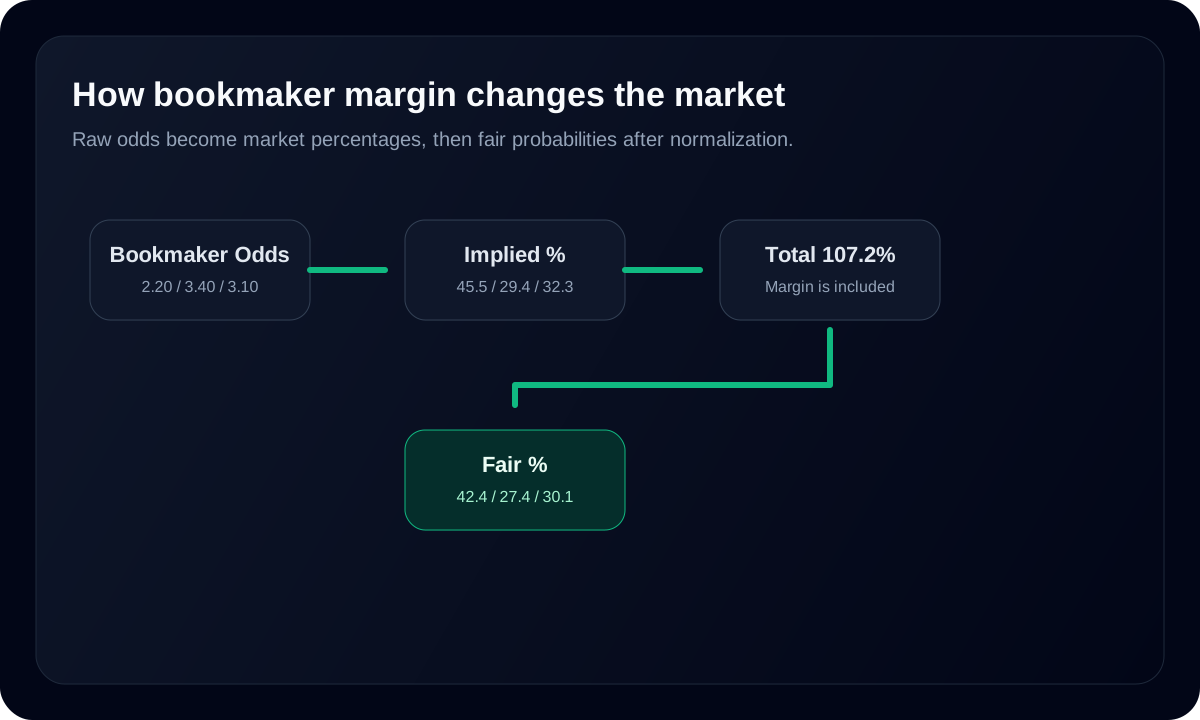 How bookmaker margin changes market percentages
What this means
- True probability should total 100 percent.
- Bookmaker total here is 105.7 percent.
- The extra 5.7 percent is bookmaker margin.
Why bookmakers use margin
- To ensure profitability regardless of outcome.
- To balance risk across markets.
- To protect against sharper bettors and pricing inefficiencies.
What the margin is doing
- You are always betting into a default disadvantage.
- The goal is not only to beat the outcome. It is to beat the price.
- Margins vary by market and league.
Margin impact by market type
| Market Type | Typical Margin |
|---|---|
| 1X2 in top leagues | 3% to 6% |
| Over and under | 4% to 7% |
| BTTS | 5% to 8% |
| Niche markets | 8% to 12% or more |
Practical interpretation
A bookmaker is not saying the odds represent an exact probability. The price is a probability adjusted to include the bookmaker's edge.
How to check if the price is still playable
When evaluating odds:
- Convert odds into implied probability.
- Estimate your own probability.
- Account for margin distortion.
- Only consider bets where the edge can overcome the bookmaker margin.
What 1X2 odds really say about a match
The 1X2 market is the most fundamental betting market in football. It represents three outcomes:
1for a home win.Xfor a draw.2for an away win.
Understanding these odds properly gives you a baseline view of market expectations before you move into other markets.
Example 1X2 odds breakdown
| Outcome | Odds | Implied Probability |
|---|---|---|
| Home win | 1.80 | 55.6% |
| Draw | 3.60 | 27.8% |
| Away win | 4.50 | 22.2% |
What these odds actually indicate
This is not a prediction. It is a pricing model.
From this table:
- The home team is a moderate favorite.
- The draw is a realistic but secondary outcome.
- The away team is a clear underdog.
Interpreting match dynamics from odds
Key signals
- Home odds below 2.00 usually imply a meaningful home edge.
- Draw odds between 3.20 and 3.60 often suggest a balanced match.
- Away odds above 4.00 usually imply a weaker squad, poor away form, or a tactical disadvantage.
Example interpretation framework
| Odds Pattern | Market Interpretation |
|---|---|
| 1.50 / 4.00 / 6.50 | Strong favorite and low upset probability |
| 2.20 / 3.30 / 3.20 | Balanced match |
| 2.80 / 3.10 / 2.50 | Slight away edge |
Why 1X2 odds matter for betting
Even if you do not bet directly on 1X2, these prices:
- Anchor all the other markets.
- Reflect overall team strength and situational context.
- Help identify mispriced secondary markets.
How to challenge the market view
If home odds are 1.80 but your analysis points to injuries, poor form, or a tactical disadvantage, the true probability may be lower than implied. That can create value on the draw, away win, or alternative markets.
Common misinterpretation
Many bettors assume the favorite is automatically a good bet. But the most likely winner can still be overpriced.
What to check before backing the favorite
Before betting on 1X2:
- Does the favorite justify its probability?
- Is the underdog undervalued relative to context?
- Does the draw probability align with team styles?
Common mistakes when interpreting football betting odds
Even when bettors understand the basics, recurring mistakes still lead to poor decisions. Most of these errors come from misinterpreting what odds actually represent.
Most frequent mistakes
Confusing probability with certainty
Many people treat 1.50 as almost guaranteed. In reality, it means 66.7 percent implied probability, which still fails about one time in three.
Ignoring bookmaker margin
Bettors often treat odds as true probabilities even though margins inflate them.
Overvaluing favorites
| Odds | Implied Probability | Reality Check |
|---|---|---|
| 1.40 | 71.4% | Still loses around 3 in 10 |
| 1.60 | 62.5% | Still fails often enough to matter |
Favorites win often, but they are also frequently overpriced.
Misunderstanding payout versus value
High odds do not automatically mean value. Low odds do not automatically mean safety.
Ignoring context behind odds
Odds reflect team strength, injuries, public patterns, and market adjustments, but they do not automatically capture every tactical nuance or hidden inefficiency.
Key warning signs of misinterpretation
- Betting because the odds look low and safe.
- Avoiding bets only because the odds are high.
- Not converting odds into probabilities.
- Ignoring line movement completely.
A better way to think about the number
Before placing any bet, filter the decision through three questions:
- What does the market expect?
- Why is this price set here?
- What might the market be missing?
Practical insight
Many losing bettors are not wrong about outcomes. They are wrong about pricing.
What to check before you bet
- Have you converted odds into probability?
- Are you aware of the bookmaker margin?
- Are you judging value rather than simply outcome likelihood?
How to identify true betting value
Identifying value is the real goal of learning how to read football betting odds. It shifts the focus from predicting outcomes to evaluating whether the offered price is mathematically justified.
What value actually means
A bet has value when:
Your estimated probability > Bookmaker implied probability
This does not guarantee a win, but it creates positive expected value over time.
Value detection example
| Scenario | Odds | Implied Probability | Your Estimate | Value |
|---|---|---|---|---|
| Team A win | 2.20 | 45.5% | 55% | Yes |
| Team B win | 1.70 | 58.8% | 52% | No |
Why value matters more than accuracy
A bettor can be correct often and still lose money by consistently taking overpriced odds.
The reverse is also true. You can be wrong often and still profit if you keep taking underpriced outcomes.
Core value indicators
The clearest value spots usually come from three places. The first is a probability mismatch, where the market underrates a team because of recent results even though the underlying performance still looks strong. The second is context the market has not fully priced, such as rotation, motivation shifts, or tactical mismatches. The third is market bias, which can push prices away from a fair number.
| Bias Type | Effect on Odds |
|---|---|
| Public favorite bias | Popular teams become overpriced |
| Recency bias | Recent results are overweighted |
| Narrative bias | Media-driven perception shifts prices |
Value vs good-looking odds
Odds of 3.00 are not valuable by default. Odds of 1.80 can still be value. It depends entirely on probability versus price.
Practical value checklist
Before placing a bet:
- What probability do the odds imply?
- What is my estimated probability?
- Is the difference meaningful?
- Is the edge large enough to beat the bookmaker margin?
What value actually looks like
Reading odds correctly is only the first step. The real skill is deciding whether the price is wrong.
What odds movement can really tell you
Odds are not static. They move in response to new information, betting volume, and market behavior. Reading those moves well helps you treat the market like a live information source rather than a fixed price list.
Types of odds movement
| Movement Type | Example | Interpretation |
|---|---|---|
| Odds shorten | 2.20 to 1.95 | Increased confidence or heavy support |
| Odds drift | 1.80 to 2.05 | Reduced confidence or opposing money |
| Stable odds | 2.00 to 2.00 | No strong signal or balanced market |
Why odds move
Odds shifts usually come from some mix of team news, lineup leaks, sharp money, public betting volume, and situational changes such as weather or fixture congestion. The important part is not just noticing that a line moved, but asking what new information the market may be reacting to.
Sharp money vs public money
| Source of Movement | Typical Effect |
|---|---|
| Sharp bettors | Earlier and more precise shifts |
| Public bettors | Later moves, often toward favorites |
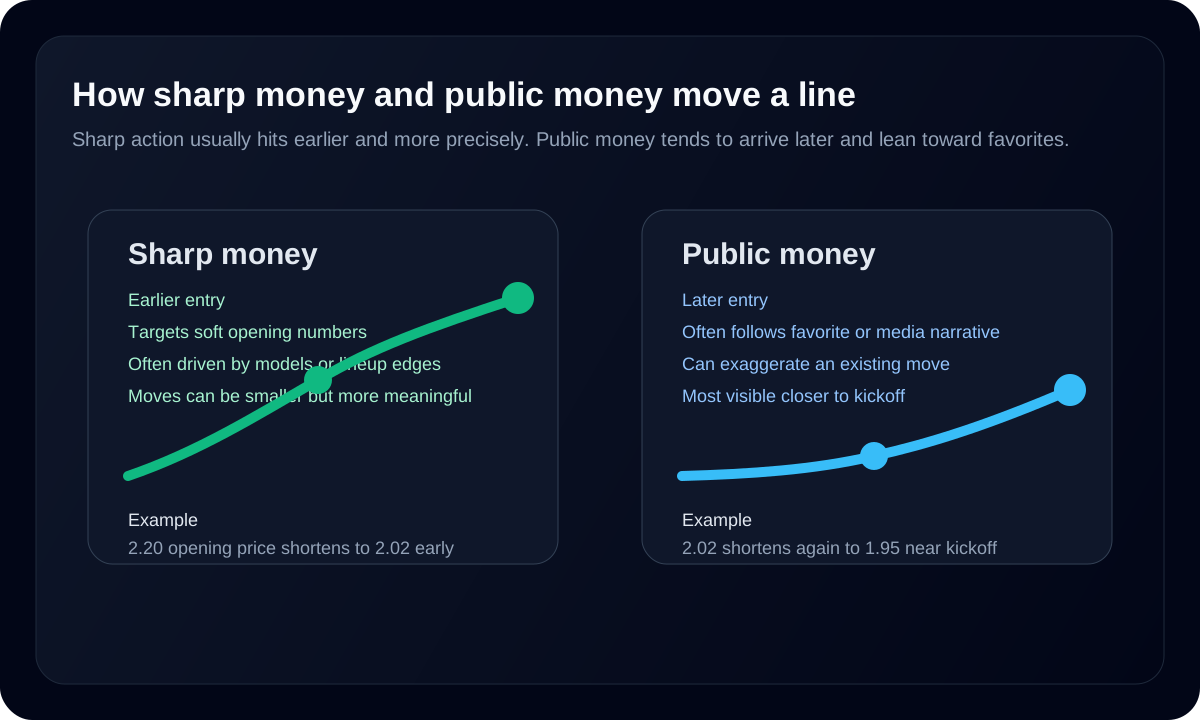 How sharp money and public money move football odds differently
Interpreting line movement
When odds shorten, the market is showing more confidence in that outcome. If a home team moves from 2.20 to 1.95, that usually means either favorable information arrived or bettors attacked what they believed was an early value price. When odds drift the opposite way, confidence is fading. A favorite moving from 1.70 to 1.90 can point to bad news, skepticism about the original line, or money coming in on the other side.
Why timing matters
| Market Phase | Characteristics |
|---|---|
| Opening odds | Model-based initial prices |
| Mid-market | Adjusted by early bettors |
| Closing odds | Most efficient and liquid |
What market movement can tell you
- Early prices can hold inefficiencies.
- Closing odds are usually the sharpest.
- Significant late movement often reflects informed money.
Common mistakes
One of the biggest mistakes is chasing movement without understanding why it happened. Another is assuming every late move is insider information when plenty of lines move for public reasons. The third is failing to act when an early number is clearly soft, then treating the closing line as if it were the same opportunity.
How to react without chasing the move
When you see movement, ask what changed, who likely caused the move, and whether the value is already gone. Odds movement is not a signal to follow blindly. It is a signal to interpret in context.
Are lower odds safer and how risk really works
One of the most common assumptions in football betting is that lower odds mean safer bets. Lower odds do imply a higher win rate, but they do not eliminate risk and they often introduce different risks that are less obvious.
Probability vs risk comparison
| Odds | Implied Probability | Loss Frequency |
|---|---|---|
| 1.30 | 76.9% | About 1 in 4 lose |
| 1.50 | 66.7% | About 1 in 3 lose |
| 2.00 | 50.0% | About 1 in 2 lose |
| 3.50 | 28.6% | About 7 in 10 lose |
What lower odds actually mean
Lower odds usually indicate:
- Higher expected win rate.
- Lower payout per bet.
- Greater sensitivity to pricing errors.
They do not mean guaranteed outcomes, low variance over time, or positive EV by default.
The hidden risk of low odds
The danger with short prices is that small mistakes hurt more than most bettors expect. At low odds, bookmaker margin eats a bigger share of your edge, which means even a minor pricing error can wipe out profitability.
One loss also does more damage than people assume:
| Odds | Outcome Sequence | Net Result |
|---|---|---|
| 1.40 | Win, win, loss | Negative |
| 1.50 | Win, win, loss | Break-even or slight loss |
That fragile profit structure is why short odds can feel comfortable while still being a poor long-term proposition. On top of that, low prices encourage overconfidence. Bettors tend to overestimate favorites, ignore context, and pile short selections into accumulators that look safe but are mathematically weak.
High odds vs low odds risk profile
| Odds Range | Risk Type | Characteristics |
|---|---|---|
| 1.20 to 1.60 | Lower variance | Frequent wins and small margins |
| 1.70 to 2.50 | Balanced | Moderate risk and reward |
| 3.00 or more | High variance | Infrequent wins and larger payouts |
What short prices really change
- Lower odds reduce variance but not necessarily risk.
- Higher odds increase variance but can still offer better value.
- The best range depends on pricing accuracy rather than comfort.
What to ask before taking a short price
Before betting on low odds:
- Is the implied probability realistic?
- Is the margin swallowing the edge?
- Would I still take this price if it moved slightly lower?
Key takeaway
Risk is not defined by odds alone. It is defined by probability accuracy, pricing efficiency, and expected value.
Comparing odds across totals BTTS and handicap markets
Understanding how to read football betting odds requires more than analyzing the 1X2 market. Different betting markets express probability in different ways, and each reveals something different about the match.
Market comparison overview
| Market Type | What It Measures | Example Odds | Interpretation Focus |
|---|---|---|---|
| 1X2 | Match outcome | 1.80 / 3.50 / 4.50 | Who is likely to win |
| Over and under | Total goals | Over 2.5 at 1.90 | Expected goal volume |
| BTTS | Both teams score | Yes at 1.75 | Mutual attacking threat |
| Handicap | Goal advantage | -1 at 2.10 | Strength gap between teams |
Over and under markets and goal expectations
| Odds | Implied View |
|---|---|
| Over 2.5 at 1.70 | High-scoring game expected |
| Over 2.5 at 2.10 | Lower scoring is more likely |
Lower odds on the over usually suggest an attacking matchup. Lower odds on the under usually suggest a defensive or slow-tempo game.
BTTS and how to read team balance
| Odds | Interpretation |
|---|---|
| Yes at 1.65 | High probability both teams score |
| No at 2.20 | One-sided or defensive expectation |
Low BTTS odds often signal that both teams create chances consistently. High BTTS odds often suggest a mismatch or defensive dominance.
Handicap markets and measuring the team-strength gap
| Handicap Line | Odds | Meaning |
|---|---|---|
| -1 | 2.00 | Favorite must win by 2 or more |
| +1 | 1.80 | Underdog can lose by 1 and still win the bet |
Lower odds on a negative handicap usually imply strong favorite dominance. Balanced handicap odds usually point to a competitive match.
Cross-market interpretation
Combining markets provides more insight than using one in isolation.
Example:
| Market | Odds | Interpretation |
|---|---|---|
| Home win | 1.75 | Moderate favorite |
| Over 2.5 | 1.65 | High goal expectation |
| BTTS yes | 1.70 | Both teams likely to score |
The likely scenario here is a home win in a match where both teams contribute goals, which may support angles such as home win plus BTTS or over 2.5 goals.
Why comparing markets gives you a clearer read
1X2 prices give you the broad match view, but they rarely tell the whole story on their own. Goal lines, BTTS prices, and handicap numbers add extra context about tempo, scoring distribution, and the real gap between the teams.
Common mistakes
The biggest mistakes here are treating each market in isolation, missing contradictions between them, and assuming every market is priced with the same level of efficiency. The most useful reads often come from noticing when one market is telling a different story from the others.
What to compare before you bet
When comparing markets:
- Do goal markets align with match outcome odds?
- Does BTTS support or contradict totals?
- Do handicap lines confirm the strength gap?
Each market is a different lens on the same match. The edge comes from identifying alignment, spotting contradictions, and exploiting pricing inconsistencies.
Building a structured approach to reading football betting odds
Understanding odds is only useful if it turns into a consistent decision-making process. Without structure, even correct insights lead to inconsistent results.
This section brings the earlier ideas together into a repeatable framework.
Step-by-step odds reading framework
| Step | Action | Purpose |
|---|---|---|
| 1 | Convert odds to probability | Understand market expectation |
| 2 | Analyze the market type | Contextualize the price |
| 3 | Account for bookmaker margin | Adjust for distortion |
| 4 | Estimate your own probability | Build an independent view |
| 5 | Compare probabilities | Identify value |
| 6 | Check odds movement | Validate or question the price |
| 7 | Assess risk level | Align with bankroll strategy |
Core principles of structured betting
Price has to come before outcome. A prediction can be right in spirit and still be a bad bet if the number is wrong. The same goes for intuition. Once you turn every opinion into a percentage, it becomes much easier to see whether you are actually spotting an edge or just backing a story you like. Market awareness matters too, because some markets are much tighter than others, while niche lines and weaker leagues are more likely to contain pricing errors.
Practical decision model
Before placing a bet, run through this checklist:
- What probability do the odds imply?
- What is my estimated probability?
- Is the difference large enough to create value?
- Does market movement confirm or contradict my view?
- What is the risk level of the bet?
Example structured evaluation
| Factor | Market View | Your View |
|---|---|---|
| Home win odds | 1.90 at 52.6% | 60% |
| Team form | Strong | Strong |
| Injuries | None | None |
| Value | — | Positive |
That gives a potential value bet rather than a blind prediction.
Risk classification model
| Category | Criteria | Example Odds Range |
|---|---|---|
| Low risk | Small edge and high probability | 1.40 to 1.70 |
| Medium value | Moderate edge | 1.80 to 2.50 |
| High variance | Larger edge and lower probability | 3.00 or more |
What a structured approach changes
- Not every match offers value.
- Passing on bets is part of a winning strategy.
- Consistency comes from process rather than outcomes.
Common pitfalls without structure
- Betting on instinct or narrative.
- Ignoring probability calculations.
- Overreacting to recent results.
- Chasing losses or short-term variance.
What consistent odds reading looks like
Reading football betting odds is not about understanding numbers in isolation. It is about building a repeatable probability-based system that filters poor bets, identifies value, and manages risk over time.
Conclusion
Learning how to read football betting odds is fundamentally about understanding probability rather than predicting results. Odds reflect market expectations shaped by data, money, and bookmaker margins, not certainty.
The advantage comes from identifying when those odds deviate from realistic probabilities. That requires converting prices into implied probability, accounting for margin, comparing multiple markets, and evaluating value rather than simple outcome likelihood.
A structured approach based on probability and risk awareness allows bettors to make more consistent decisions. Not every opportunity should be played, and long-term performance depends more on pricing discipline than short-term accuracy.
TipSignal next step
Use this on the live predictions board
See how these pricing and market ideas connect to TipSignal's live daily board before the shortlist gets narrowed.
Check today's football predictions