
Implied Probability in Football Betting for Reading Odds Better
Learn how implied probability in football betting works, how to convert odds, remove margin, and identify value using a structured, data-driven approach.
In this article
- What implied probability means in football betting
- How to convert football odds into implied probability
- Bookmaker margin and why the market is not fully fair
- Fair probability and implied probability in football betting
- Where value shows up in football odds
- Using implied probability in 1X2 football markets
- How team form and match context shift true probability
- Using implied probability in over under and BTTS markets
- Common implied probability football betting mistakes
- A practical framework for using implied probability in football betting
Understanding implied probability in football betting is one of the foundations of any data-driven approach. Every set of odds represents a percentage chance, and understanding that conversion allows you to evaluate whether a price is reasonable or not.
Most bettors look at odds as numbers. Better betting processes treat odds as probabilities first and prices second.
Once you translate odds into probability, you can compare the bookmaker's expectation with your own assessment of the match. That gap is where value may exist.
This guide focuses on how to calculate, interpret, and apply implied probability in real football betting decisions while accounting for margin, uncertainty, and market bias.
If you are new to the pricing side of betting, pair this article with how to read football betting odds and value betting football. Once you are comfortable with the conversion, compare it with the live football predictions today board to see how the market and the model can diverge in real time.
Start here
Football Betting Strategy for Smarter Long Term Decisions
This guide sits inside a wider topic path. Read the core concept first if you want the parent framework before the deeper market detail.
Read the core conceptWhat implied probability means in football betting
Implied probability is the percentage chance of an outcome suggested by bookmaker odds. It converts prices into a format that is easier to evaluate and compare.
For example, odds of 2.00 do not just mean even odds. They imply a 50 percent chance of the outcome happening. This translation is what allows bettors to move from guessing to structured analysis.
Example odds to implied probability
| Odds (Decimal) | Implied Probability |
|---|---|
| 1.50 | 66.7% |
| 2.00 | 50.0% |
| 3.00 | 33.3% |
| 5.00 | 20.0% |
The calculation is straightforward:
This simplicity is why implied probability is widely used in analytical betting models.
Why this matters for betting decisions
- It standardizes all odds into a comparable format.
- It allows direct comparison between different bookmakers.
- It highlights whether a price reflects realistic expectations.
- It forms the basis for identifying value.
Key insight
Implied probability does not tell you what will happen. It tells you what the market expects to happen. The difference between expectation and reality is where betting decisions are made.
How to convert football odds into implied probability
Converting odds into implied probability is the core mechanical skill behind this type of football betting analysis. Without this step, it is not possible to evaluate whether odds represent value or simply reflect market expectation.
Most football bettors use decimal odds, so the conversion process is direct and consistent.
Core conversion formula
| Odds Format | Formula | Example |
|---|---|---|
| Decimal | 1 ÷ Odds | 1 ÷ 2.50 = 40% |
| Fractional | Denominator ÷ (Numerator + Denominator) | 2/1 = 1 ÷ (2 + 1) = 33.3% |
| American (+) | 100 ÷ (Odds + 100) | +150 = 100 ÷ 250 = 40% |
| American (-) | Odds ÷ (Odds + 100) | -200 = 200 ÷ 300 = 66.7% |
For football betting, the decimal format is the most relevant, especially when comparing multiple markets quickly.
Practical example with a 1X2 football market
| Outcome | Odds | Implied Probability |
|---|---|---|
| Home Win | 2.20 | 45.5% |
| Draw | 3.40 | 29.4% |
| Away Win | 3.10 | 32.3% |
At first glance, these probabilities may seem reasonable. However, adding them together gives:
45.5% + 29.4% + 32.3% = 107.2%
That is a critical observation because the total exceeds 100 percent, which reflects bookmaker margin.
Step by step conversion process
- Take the decimal odds.
- Divide 1 by the odds.
- Multiply by 100 to get a percentage.
- Compare across all outcomes.
This process takes seconds but fundamentally changes how odds are interpreted.
Key applications in betting analysis
- Comparing prices across bookmakers.
- Identifying overpriced or underpriced outcomes.
- Evaluating whether odds align with team performance data.
- Building probability-based betting models.
Important limitation
Conversion alone does not create an edge. It only translates bookmaker pricing into probability form. The edge comes from comparing these probabilities with your own estimates, which should be based on data such as:
- Team form.
- Expected goals and underlying chance quality.
- Injuries and squad depth.
- Tactical matchups.
Conversion is the starting point, not the conclusion.
Bookmaker margin and why the market is not fully fair
When working with implied probability in football betting, one of the most important adjustments is understanding bookmaker margin. The probabilities derived from odds do not represent a neutral estimate. They include a built-in edge for the bookmaker.
This margin, often called the overround, ensures that the total implied probability across all outcomes exceeds 100 percent.
Example of bookmaker margin
| Outcome | Odds | Implied Probability |
|---|---|---|
| Home Win | 2.20 | 45.5% |
| Draw | 3.40 | 29.4% |
| Away Win | 3.10 | 32.3% |
| Total | — | 107.2% |
The extra 7.2 percent represents the bookmaker's margin. This is how sportsbooks protect their long-term profitability regardless of match outcome.
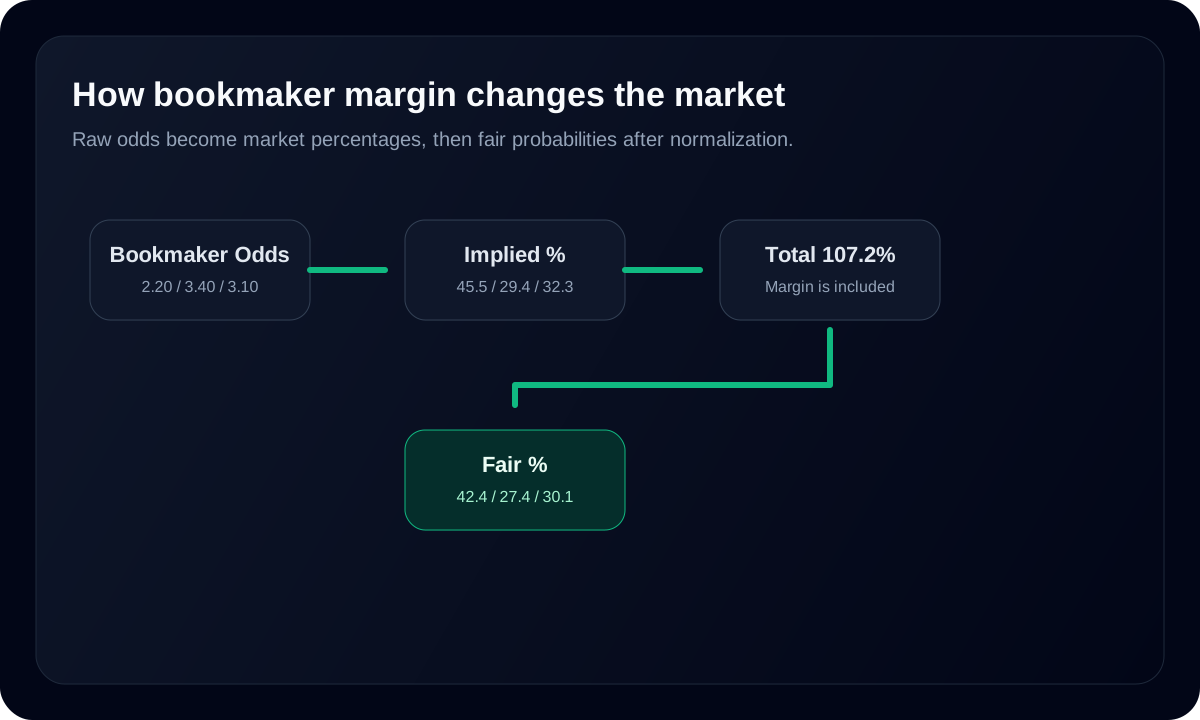 Placeholder graphic showing bookmaker odds flowing into implied probabilities, total margin above 100 percent, and normalized fair probabilities.
Why margin matters for bettors
- It inflates implied probabilities above true likelihood.
- It hides the fair price of outcomes.
- It reduces long-term expected value if not accounted for.
- It makes raw probability comparisons misleading.
Without adjusting for margin, bettors may believe an outcome is more likely than it actually is.
Converting to fair probabilities
To remove the margin, probabilities must be normalized:
- Calculate implied probabilities.
- Add them together.
- Divide each implied probability by the total.
Adjusted fair probabilities
| Outcome | Implied % | Fair % |
|---|---|---|
| Home Win | 45.5% | 42.4% |
| Draw | 29.4% | 27.4% |
| Away Win | 32.3% | 30.1% |
Now the total equals 100 percent, which gives a neutral market baseline without bookmaker edge.
Key insight for betting decisions
The difference between implied probability and fair probability is critical:
- Implied probability means bookmaker view plus margin.
- Fair probability means market expectation without margin.
That distinction lets you compare your own estimate against a corrected market baseline instead of a distorted one.
Practical implications
- A bet is not value simply because the odds look high.
- You should compare against fair probability, not raw implied probability.
- Smaller margins often signal sharper markets.
- Larger margins make long-term profitability harder.
More structured betting processes usually remove margin before comparing prices at all.
Fair probability and implied probability in football betting
Understanding the difference between fair probability and implied probability is where analytical betting begins to move beyond basic odds reading.
Implied probability reflects the bookmaker's pricing, including margin. Fair probability removes that margin and represents a more neutral estimate of how likely each outcome is within the market.
Side by side comparison
| Concept | Definition | Includes Margin | Use Case |
|---|---|---|---|
| Implied Probability | Probability derived directly from odds | Yes | Quick market interpretation |
| Fair Probability | Adjusted probability after removing margin | No | Accurate comparison baseline |
This distinction is not theoretical. It directly affects whether a bet is considered value or not.
Market probability versus fair probability
| Outcome | Odds | Implied % | Fair % |
|---|---|---|---|
| Home Win | 2.20 | 45.5% | 42.4% |
| Draw | 3.40 | 29.4% | 27.4% |
| Away Win | 3.10 | 32.3% | 30.1% |
If a bettor evaluates the home win at 45.5 percent, they are unknowingly including bookmaker margin. The more useful comparison point is 42.4 percent.
Why this matters for value detection
Value exists only when:
Your estimated probability > Fair probability
Not:
Your estimated probability > Implied probability
That is a common mistake that leads to overestimating betting edges.
Practical comparison framework
To evaluate a bet properly:
- Convert odds into implied probability.
- Remove margin to get fair probability.
- Estimate your own probability using data.
- Compare the two.
Example decision scenario
| Outcome | Fair Probability | Your Estimate | Value |
|---|---|---|---|
| Home Win | 42.4% | 46% | Yes |
| Draw | 27.4% | 25% | No |
| Away Win | 30.1% | 29% | No |
Only the home win shows a potential edge, and even then the margin is relatively small.
Key insights for disciplined betting
- Fair probability is the correct baseline for analysis.
- Small percentage differences can still matter over time.
- Edges are often thin, not obvious.
- Misreading margin leads to consistent overestimation of value.
Risk considerations
Even when your probability is higher than the fair probability:
- Outcomes remain uncertain.
- Variance in football is high.
- Short-term results can differ from long-term expectation.
That is why edge size matters just as much as direction.
Where value shows up in football odds
In implied-probability analysis, value is not about finding the most likely outcome. It is about finding mispriced probability.
A team can be very likely to win and still offer no value. An unlikely outcome can still be a value bet if the odds underestimate its true probability.
Defining value in probability terms
Value exists when:
Your estimated probability > Fair market probability
That difference is often small, but over time it is what determines profitability in disciplined betting strategies.
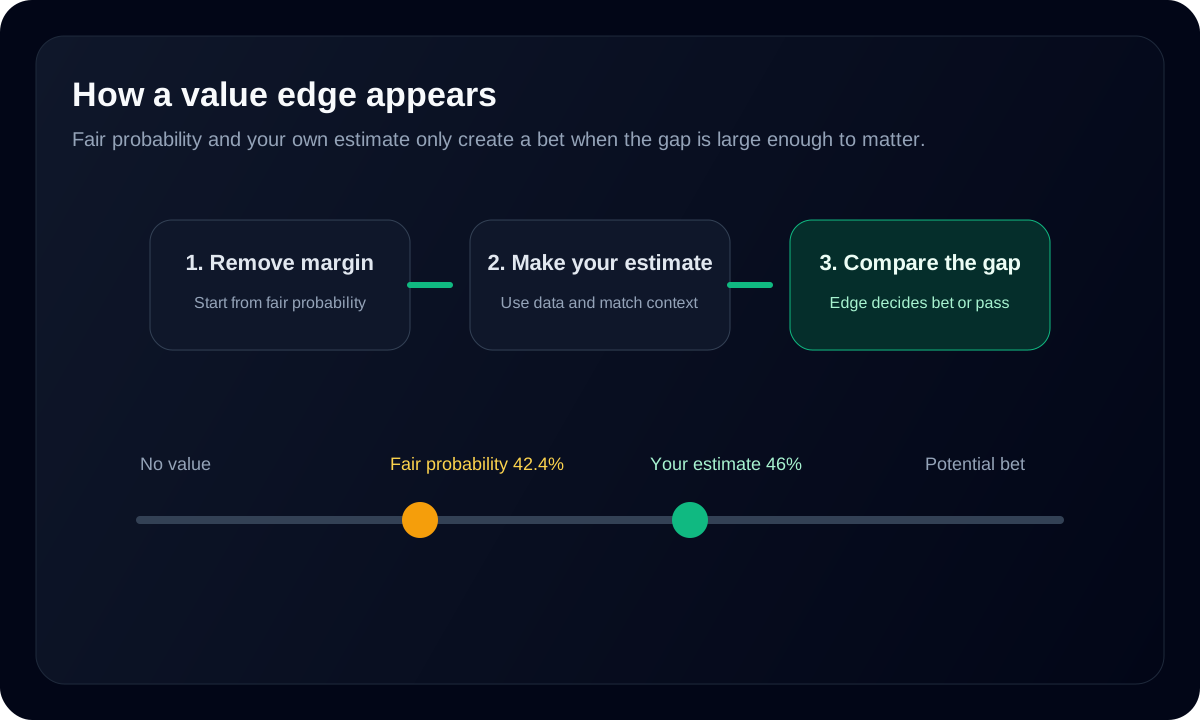 Placeholder graphic comparing fair probability with your estimated probability to show when a betting edge appears.
Example of identifying value
| Outcome | Odds | Fair Probability | Your Estimate | Value Edge |
|---|---|---|---|---|
| Home Win | 2.20 | 42.4% | 46% | +3.6% |
| Draw | 3.40 | 27.4% | 25% | -2.4% |
| Away Win | 3.10 | 30.1% | 29% | -1.1% |
Only the home win qualifies as a value opportunity, and even then the edge is relatively small.
Where value typically appears in football markets
Value is rarely obvious. It tends to appear in situations such as:
- Market overreaction to recent results.
- Undervalued underdogs with stronger underlying numbers than the headlines suggest.
- Injury or team news that is not fully priced in.
- Public bias toward popular teams.
- Fixture congestion or rotation risk.
Types of value opportunities
| Type | Description | Risk Level |
|---|---|---|
| Small Edge Value | 1 to 3 percent probability difference | Lower |
| Medium Edge Value | 3 to 6 percent difference | Moderate |
| High Edge Value | 6 percent plus | Higher and often more volatile |
Value is not only about finding the edge. It is also about deciding whether the edge is worth the variance that comes with it.
Key decision factors before placing a bet
- Is your probability estimate based on reliable data?
- Has the bookmaker margin been removed?
- Is the edge large enough to justify variance?
- Are there hidden factors such as injuries, motivation, or tactics?
Important reality check
Not every perceived edge is real. Common issues include:
- Overconfidence in subjective judgment.
- Misinterpreting short-term form.
- Ignoring matchup-specific dynamics.
- Underestimating randomness in football.
Even accurate value bets can lose frequently in the short term. That is why probability-based betting focuses on long-term expectation, not individual outcomes.
TipSignal next step
Use this on the live predictions board
See how these pricing and market ideas connect to TipSignal's live daily board before the shortlist gets narrowed.
Compare live football predictions against the marketUsing implied probability in 1X2 football markets
The 1X2 market, home win, draw, or away win, is the most common application of implied probability in football betting. It is also one of the most misunderstood because it involves three outcomes instead of two.
Each outcome has its own implied probability, and together they form a complete picture of how the market prices the match.
Example 1X2 market breakdown
| Outcome | Odds | Implied Probability | Fair Probability |
|---|---|---|---|
| Home Win | 1.85 | 54.1% | 51.8% |
| Draw | 3.60 | 27.8% | 26.6% |
| Away Win | 4.20 | 23.8% | 21.6% |
| Total | — | 105.7% | 100% |
This table shows two layers:
- Implied probability includes margin.
- Fair probability gives the adjusted baseline for analysis.
How to interpret 1X2 probabilities
In football, probability distribution is influenced by the low-scoring nature of the sport. This creates:
- Higher draw probability than in many other sports.
- Tighter margins between outcomes.
- Greater impact from single events such as penalties or red cards.
Key interpretation rules
- Favourites rarely exceed 60 to 65 percent in balanced leagues.
- Draw probabilities typically sit between 22 and 30 percent.
- Underdogs often retain realistic win chances.
This is why even strong teams lose more often than casual bettors expect.
Identifying value within 1X2 markets
To evaluate a potential bet:
- Use fair probability as your baseline.
- Estimate your own probability.
- Compare the difference.
Example decision table
| Outcome | Fair Probability | Your Estimate | Edge | Decision |
|---|---|---|---|---|
| Home Win | 51.8% | 50% | -1.8% | No Bet |
| Draw | 26.6% | 30% | +3.4% | Consider |
| Away Win | 21.6% | 20% | -1.6% | No Bet |
In this case, the draw becomes the only potential value option even though it is not the most likely outcome.
Common patterns in 1X2 pricing
- Favourites are often slightly overpriced because of public betting volume.
- Draws can be undervalued, especially in evenly matched games.
- Away teams are frequently mispriced in leagues with a strong home-bias narrative.
Practical checklist for 1X2 betting
- Compare implied and fair probability.
- Assess team strength beyond surface results.
- Consider tactical matchup and game state.
- Evaluate motivation such as title races, relegation pressure, or rotation.
- Check whether draw probability is being overlooked.
Risk perspective
Even well-calculated 1X2 value bets carry significant variance:
- Draws are inherently unpredictable.
- Underdog wins occur regularly.
- Small edges can take time to materialize.
That is why patience matters as much as analysis.
How team form and match context shift true probability
Implied probability becomes more useful when combined with contextual analysis. Odds reflect market expectations, but they do not always fully account for dynamic factors such as form, injuries, or tactical matchups.
This is where bettors try to build an edge by identifying when real match conditions differ from how the market is pricing the game.
Core factors that influence true probability
- Recent team form and the difference between results and performance.
- Expected goals trends.
- Injuries and squad availability.
- Tactical matchups and playing styles.
- Motivation, such as title races, relegation pressure, or rotation.
- Schedule congestion and fatigue.
These elements directly affect the true probability, which may differ from the implied or even fair probability.
Example of form versus market expectation
| Factor | Team A Home | Team B Away |
|---|---|---|
| Last 5 Results | W-W-D-W-L | L-D-L-W-L |
| xG average | 1.85 | 1.10 |
| xGA average | 0.95 | 1.60 |
| Key Injuries | None | 2 starters out |
| Rest Days | 6 | 3 |
From a surface-level view, the market may already price Team A as favourite. However, the underlying data strengthens that position:
- Better attacking output.
- Stronger defensive numbers.
- More rest and fewer injuries.
That could justify increasing your estimated probability beyond the market's fair probability.
When form can be misleading
One of the most common mistakes is overvaluing recent results instead of performance data.
For example:
- A team winning 3 to 0 with low xG may be overperforming.
- A team losing narrowly with strong xG may be undervalued.
Red flags in form analysis
- Results driven by penalties or red cards.
- Unsustainable finishing.
- Defensive overperformance compared with xGA.
These situations often lead to market mispricing in later matches.
Tactical matchups and probability shifts
Not all teams interact the same way tactically. Style clashes can significantly affect probabilities:
- Possession-heavy teams against high-press teams.
- Defensive low blocks against direct attacking sides.
- Teams vulnerable to set pieces against strong aerial opponents.
These nuances are often underrepresented in basic odds models.
Practical adjustment framework
To refine your probability estimate:
- Start with fair probability.
- Adjust based on team strength indicators.
- Apply context modifiers such as injuries, rest, and motivation.
- Reassess tactical compatibility.
- Compare your adjusted probability to the market.
Example probability adjustment
| Outcome | Fair Probability | Adjusted Estimate |
|---|---|---|
| Home Win | 51.8% | 56% |
| Draw | 26.6% | 25% |
| Away Win | 21.6% | 19% |
Here, contextual factors increase the home win probability, potentially creating a value opportunity if the market has not fully adjusted.
Key insight
Markets are efficient, but not perfect. The edge often comes from:
- Interpreting context faster or more accurately than the market.
- Avoiding overreaction to short-term results.
- Focusing on performance metrics instead of outcomes.
Using implied probability in over under and BTTS markets
Implied probability is not limited to 1X2 markets. In practice, many bettors focus on totals and both teams to score because these markets can offer clearer statistical edges.
These markets are often more directly linked to measurable data such as expected goals, shot volume, and defensive efficiency.
Example over under market conversion
| Market | Odds | Implied Probability | Fair Probability |
|---|---|---|---|
| Over 2.5 Goals | 1.90 | 52.6% | 50.8% |
| Under 2.5 Goals | 1.95 | 51.3% | 49.2% |
| Total | — | 103.9% | 100% |
Here, the margin is smaller than in many 1X2 markets, which is common in high-liquidity goal markets.
Why these markets are analytically useful
- Goal-based outcomes align closely with xG data.
- There is less influence from big-club narratives.
- Statistical patterns can be more stable over time.
- They are often easier to model than match winners.
Example BTTS market
| Market | Odds | Implied Probability | Fair Probability |
|---|---|---|---|
| Yes | 1.80 | 55.6% | 53.2% |
| No | 2.05 | 48.8% | 46.8% |
| Total | — | 104.4% | 100% |
BTTS markets are strongly influenced by:
- Attacking consistency.
- Defensive vulnerability.
- Game-state tendencies.
Key factors for over under analysis
- Average xG for both teams.
- xGA and defensive chance quality allowed.
- Shot volume and shot quality.
- Tempo and playing style.
- Game importance and likely openness.
Key factors for BTTS analysis
- Frequency of both teams scoring in recent matches.
- Clean sheet rates.
- Defensive structure and errors.
- Home and away goal patterns.
- Tactical approach.
Example of data-driven evaluation
| Metric | Team A | Team B |
|---|---|---|
| Average xG | 1.75 | 1.60 |
| Average xGA | 1.20 | 1.40 |
| BTTS Rate | 70% | 65% |
| Over 2.5 Rate | 68% | 62% |
This profile suggests:
- High likelihood of goals.
- Both teams are capable of scoring.
- Defensive vulnerabilities exist on both sides.
If the fair probability for BTTS Yes is 53 percent, but your model estimates something closer to 60 percent, that could indicate value.
Common market patterns
- Over 2.5 can be slightly overpriced in popular leagues.
- Under markets can offer value in tactically cautious matchups.
- BTTS Yes is frequently influenced by recent high-scoring games.
- BTTS No can be undervalued when one team is defensively dominant.
Risk considerations
- Goals are still subject to finishing variance.
- Early goals can distort match flow.
- Red cards significantly impact totals markets.
- Small edges require long-term consistency.
Practical takeaway
Compared with 1X2 markets, over under and BTTS markets:
- Are often more data-aligned.
- May offer clearer probability edges.
- Still require margin adjustment and disciplined estimation.
They are not inherently easier, but they are often more suitable for structured probability-based betting.
Common implied probability football betting mistakes
Even when bettors understand implied probability, mistakes still happen in interpretation and application. These usually come from misreading probabilities, ignoring margin, or overestimating analytical accuracy.
Avoiding these errors is often more important than finding new angles because they directly affect long-term decision quality.
Most frequent mistakes
- Ignoring bookmaker margin.
- Confusing probability with certainty.
- Overestimating small edges.
- Relying too heavily on recent results.
- Not accounting for market efficiency.
- Forcing bets without clear value.
Example of misinterpreting probability
| Scenario | Implied Probability | Reality |
|---|---|---|
| Strong favourite | 65% | Still loses 35% of the time |
| Balanced match | 45% vs 30% vs 25% | All outcomes remain realistic |
| Underdog | 20% | Wins 1 in 5 matches on average |
That highlights a key point. Probability describes frequency, not certainty.
Margin related mistakes
| Mistake | Consequence |
|---|---|
| Using implied probability directly | Overestimating true chances |
| Comparing odds without normalization | False value detection |
| Ignoring high-margin markets | Reduced long-term returns |
Markets with higher margins require more caution because the bookmaker edge is larger.
Analytical errors in probability estimation
- Overconfidence in subjective judgment.
- Misreading tactical matchups.
- Ignoring squad rotation or fatigue.
- Failing to adjust for injuries.
- Using incomplete or biased data.
Decision making mistakes
- Chasing losses instead of sticking to probability logic.
- Increasing stake size based on confidence rather than edge.
- Treating all value bets as equal.
- Ignoring variance and short-term swings.
Structured approaches usually reduce these mistakes by separating bets by edge size and uncertainty instead of treating every value bet the same way.
Key takeaway
Most betting losses are not caused by bad luck alone. They are usually caused by:
- Poor probability interpretation.
- Lack of discipline.
- Ignoring market structure.
Improving those areas often helps more than trying to predict more winners.
A practical framework for using implied probability in football betting
Understanding implied probability in football betting is only useful if it leads to consistent, repeatable decisions. The goal is not to predict outcomes perfectly, but to apply a structured process that identifies potential value while managing risk.
This framework focuses on turning theory into practical application.
Step by step betting framework
| Step | Action | Purpose |
|---|---|---|
| 1 | Convert odds to implied probability | Understand market expectation |
| 2 | Remove margin to get fair probability | Establish a proper baseline |
| 3 | Analyze match context | Build your own estimate |
| 4 | Compare probabilities | Identify potential edge |
| 5 | Classify risk level | Decide whether to bet |
Each step builds on the previous one. Skipping any step increases the likelihood of poor decisions.
Practical workflow example
| Outcome | Fair Probability | Your Estimate | Edge | Classification |
|---|---|---|---|---|
| Home Win | 51% | 55% | +4% | Medium Value |
| Draw | 27% | 25% | -2% | No Bet |
| Away Win | 22% | 20% | -2% | No Bet |
Only one outcome qualifies as a potential bet, and even then the edge is moderate rather than decisive.
Decision criteria before placing a bet
- Is the probability edge clear and measurable?
- Is the edge large enough to justify variance?
- Are assumptions supported by data such as xG, form, and injuries?
- Has bookmaker margin been removed?
- Are there hidden risks such as rotation, motivation, or tactical mismatch?
If any of these are unclear, the correct decision is often no bet.
Risk classification approach
| Range | Profile | Typical Interpretation |
|---|---|---|
| 1 to 2% | Low edge | Often not worth betting after margin |
| 3 to 5% | Medium edge | Most realistic value opportunities |
| 6% plus | High edge | Higher variance and needs extra caution |
More disciplined systems often prioritise medium-edge opportunities, where probability advantage and risk are more balanced.
Key principles for long term consistency
- Focus on probability differences, not outcomes.
- Accept that even correct bets lose frequently.
- Avoid forcing bets without clear value.
- Treat betting as a series of decisions, not isolated events.
- Continuously refine probability estimation.
Common decision outcomes
| Scenario | Decision |
|---|---|
| Your probability is below fair probability | No bet |
| Small edge below 2% | Usually no bet |
| Moderate edge between 3% and 5% | Consider |
| Large edge above 6% | Evaluate risk carefully |
This reinforces a key idea. Most matches should not be bet on.
Final insight
Implied probability is not about finding certainty. It is about identifying small, repeatable advantages in a market that is generally efficient.
The edge does not come from knowing the winner. It comes from recognizing when the market price does not fully reflect reality.
Conclusion
Implied probability provides a structured way to interpret odds, compare market expectations, and identify potential value. By converting odds into probability, adjusting for bookmaker margin, and building independent estimates based on data and context, bettors can make more informed decisions.
The key takeaway is not that value bets guarantee success, but that they improve long-term expectation when applied consistently. Edges are typically small, variance is unavoidable, and discipline is essential.
A probability-based approach shifts the focus from outcomes to decision quality, which is the only part a bettor can truly control.