
Draw No Bet Football Betting for Better Risk Control
Draw no bet in football betting explained with data-driven strategy, odds analysis, and a practical framework to identify real value.
In this article
- What draw no bet actually means
- Draw no bet vs 1X2 and double chance
- Where draw no bet offers the most value
- Implied probability and pricing in draw no bet markets
- Team signals that support a draw no bet pick
- Which leagues and match types fit this market best
- Using form and xG to evaluate draw no bet selections
- Key risks to review before placing a draw no bet bet
- Common draw no bet mistakes that cost value
- A practical framework for choosing draw no bet bets
Draw no bet is a risk-adjusted market designed to remove one of the most common outcomes in football, the draw. If the match ends level, your stake is refunded, which changes both the risk profile and the pricing of the bet.
From a betting point of view, this market becomes relevant in matches where:
- One team has a clear edge but not enough to justify short 1X2 odds.
- The probability of a draw is significant.
- You want to reduce downside variance without moving into overly conservative markets.
Draw no bet is not safer by default. It is only valuable when the price correctly reflects the reduced risk.
This market becomes much clearer when you read it next to double chance betting in football, Asian handicap football betting, and the live best football tips today shortlist. Those comparisons show when draw protection helps, when handicap precision is better, and when the market is simply overcharging for safety.
Start here
Football Betting Strategy for Smarter Long Term Decisions
This guide sits inside a wider topic path. Read the core concept first if you want the parent framework before the deeper market detail.
Read the core conceptWhat draw no bet actually means
Draw no bet removes the draw outcome from a traditional 1X2 market. Instead of three possible results, the bet effectively works with two:
- Win means the bet wins.
- Draw means the stake is refunded.
- Loss means the bet loses.
This structure shifts both probability distribution and bookmaker pricing.
Outcome comparison table
| Match Result | 1X2 Bet on Home | Draw No Bet on Home |
|---|---|---|
| Home win | Win | Win |
| Draw | Loss | Refund |
| Away win | Loss | Loss |
The refund condition is the defining feature. That protection comes at a cost through lower odds than a standard win bet.
How pricing adjusts
| Market Type | Typical Odds Example | Risk Level |
|---|---|---|
| 1X2 home win | 2.10 | Higher |
| Draw no bet home | 1.55 to 1.65 | Medium |
| Double chance 1X | 1.25 to 1.35 | Lower |
The core trade-off is simple. You are paying for draw protection through reduced odds.
What that changes for bettors
- Draw probability is removed, but the value does not disappear automatically.
- Bookmakers adjust margins differently in DNB markets.
- Value depends on whether draw likelihood is overpriced or underpriced.
Structured models often treat DNB selections as controlled-risk plays rather than genuinely low-risk bets.
When the market becomes relevant
Draw no bet becomes particularly useful when:
- A stronger team plays away.
- A favorite has strong control but inconsistent finishing.
- Two evenly matched teams still show asymmetric upside.
In those cases, the draw is a realistic outcome without being the most likely one.
Draw no bet vs 1X2 and double chance
Understanding how draw no bet compares with the other core football markets is essential if the goal is rational market selection rather than habit.
Each market reflects a different balance between risk, probability, and price.
Market structure comparison
| Market Type | Outcomes Covered | Draw Outcome | Typical Odds Range | Risk Profile |
|---|---|---|---|---|
| 1X2 win | Win only | Loss | High | High |
| Draw no bet | Win only | Refund | Medium | Medium |
| Double chance | Win and draw | Win | Low | Lower |
This highlights the trade-off clearly:
- 1X2 maximizes payout but carries full draw risk.
- Double chance minimizes risk but often removes too much value.
- Draw no bet sits in the middle, which makes pricing especially important.
Odds vs probability trade-off
| Scenario | 1X2 Odds | DNB Odds | Double Chance Odds | Best Use Case |
|---|---|---|---|---|
| Strong favorite | 1.60 | 1.30 | 1.15 | 1X2 preferred |
| Moderate favorite | 2.10 | 1.60 | 1.35 | DNB viable |
| Balanced match | 2.60 | 1.85 | 1.50 | DNB strongest |
| Underdog lean | 3.20 | 2.20 | 1.70 | Case dependent |
The market usually becomes most efficient in moderately priced matches rather than obvious favorite spots.
Practical differences in decision-making
When comparing these markets, bettors should evaluate:
- Draw probability.
- Edge versus protection.
- Market efficiency.
High draw likelihood usually makes DNB more relevant. Low draw likelihood makes 1X2 more efficient. Overusing DNB for protection often erodes upside without fixing bad pricing.
How the trade-off works
- Draw no bet is not a safe version of 1X2. It is a repriced market.
- Double chance often removes too much value for serious betting.
- 1X2 remains optimal when draw probability is low and favorite dominance is clear.
- DNB works best when a team looks more reliable at avoiding defeat than winning outright.
TipSignal next step
Apply it on the safer shortlist
See how the stronger, lower-variance selections are filtered once price, probability, and shortlist quality are judged together.
See today's best football tipsWhere draw no bet offers the most value
Not every match is suitable for this market. The value of DNB depends heavily on match balance, draw probability, and pricing inefficiency.
The key is finding match profiles where the draw is realistic but not dominant.
Match profile suitability
| Match Type | Draw Probability | DNB Value Potential | Reasoning |
|---|---|---|---|
| Strong favorite vs weak underdog | Low | Low | Draw unlikely so 1X2 is better |
| Moderate favorite vs competitive team | Medium | High | Draw risk may be priced inefficiently |
| Balanced teams | High | Medium to high | Refund adds value if edge exists |
| Defensive vs defensive | High | Medium | Draws are frequent but edge may be thin |
| Away favorite with slight edge | Medium | High | Away risk offset by refund |
The strongest zone is usually moderate favorites in competitive matches, especially away from home.
Situations where DNB performs best
- Away teams with better underlying metrics but inconsistent results.
- Home teams that rarely lose but struggle to dominate.
- Matches where tactical setups limit goal volume.
- Fixtures with historically high draw frequency.
These scenarios create asymmetry:
- The team you back is more likely to win than lose.
- The draw still occurs often enough to justify protection.
Indicators of potential value
| Indicator | Why It Matters |
|---|---|
| Draw rate above league average | Increases refund probability |
| Low goal expectation | More draws make DNB more relevant |
| Narrow odds gap | Signals a competitive match |
| Strong defensive metrics | Reduces loss probability |
| Away team stronger on xG | Hidden edge often mispriced |
Where the value usually shows up
The most consistent DNB opportunities often follow these patterns:
- Better team, wrong venue.
- Control without dominance.
- High-draw leagues.
- Market hesitation spots.
When DNB does not offer value
Avoid using it in these cases:
- Heavy favorites with low draw probability.
- Matches with high expected goals.
- Teams with volatile defensive profiles.
- Situations where odds are already heavily compressed.
DNB becomes a strategic pricing play only when win probability exceeds loss probability by a clear margin and the draw still carries real weight.
Implied probability and pricing in draw no bet markets
Pricing is the part that makes this market work or fail long term. A bet can be logically sensible and still be mathematically poor if the odds are inefficient.
The key is converting odds into implied probability and comparing that number with your estimated true chance.
Converting odds to implied probability
| Odds | Implied Probability |
|---|---|
| 1.50 | 66.7% |
| 1.70 | 58.8% |
| 1.90 | 52.6% |
| 2.10 | 47.6% |
| 2.30 | 43.5% |
Conceptually:
In DNB markets this probability reflects only win and loss states because the draw becomes a refund.
Comparing 1X2 vs draw no bet pricing
| Market Outcome | Odds | Implied Probability |
|---|---|---|
| Home win 1X2 | 2.20 | 45.5% |
| Draw | 3.30 | 30.3% |
| Away win | 3.40 | 29.4% |
| Home DNB | 1.60 | 62.5% |
At first glance the DNB price looks attractive, but the key question is whether that implied number matches the true win probability once draws are removed.
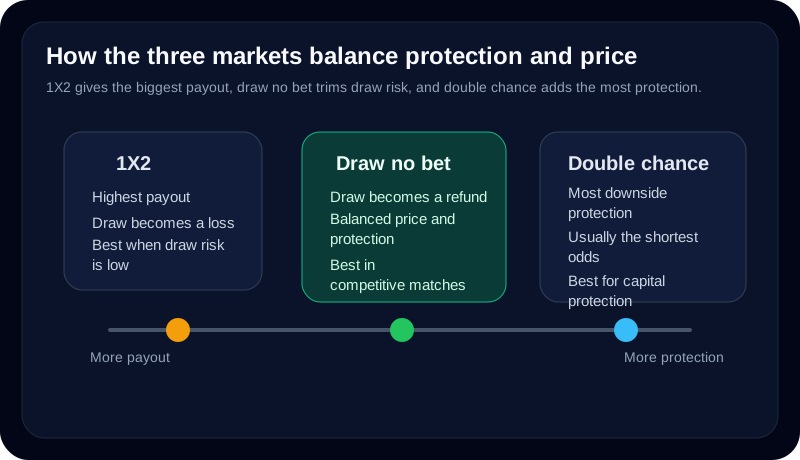 How 1X2, draw no bet, and double chance trade price for protection.
Adjusting for the draw
To evaluate a DNB properly, you need to remove draw probability from the equation.
Example:
| Outcome | Probability |
|---|---|
| Home win | 45% |
| Draw | 30% |
| Away win | 25% |
Remove the draw and redistribute the remaining 70 percent:
Value assessment table
| Metric | Value |
|---|---|
| Adjusted home win probability | 64.3% |
| Implied probability at 1.60 | 62.5% |
| Value edge | +1.8% |
This is a positive value scenario because the estimated chance exceeds the implied chance.
Key pricing insights
- DNB odds often include hidden margin compression.
- Bookmakers tend to overprice safety, especially in popular matches.
- Small edges of 1 to 3 percent are normal.
What to look for in pricing
- DNB odds that do not fully account for high draw probability.
- Competitive 1X2 markets where DNB still leans too heavily toward the favorite.
- Cases where public sentiment pushes prices down faster than the true probability changes.
Practical checklist for bettors
Before placing a DNB wager:
- Estimate realistic probabilities.
- Adjust for draw removal.
- Compare adjusted probability with implied probability.
- Look for at least a small but clear edge.
Without this step, DNB becomes only a variance-reduction tool instead of a profit-generating market.
Team signals that support a draw no bet pick
This market is highly dependent on team profile rather than raw win percentage. The goal is not only to back the better team. It is to identify teams that are unlikely to lose.
DNB rewards loss avoidance more than dominance.
Core team profile metrics
| Metric | Strong DNB Signal | Weak DNB Signal |
|---|---|---|
| Loss rate | Low | High |
| Draw frequency | Medium to high | Very low |
| Goals conceded | Low | High |
| xGA | Low | High |
| Game control | Stable | Volatile |
Teams that avoid defeat consistently, even if they draw often, are ideal candidates.
Home vs away stability
| Team Type | DNB Suitability | Reasoning |
|---|---|---|
| Strong home team | High | Rarely loses at home |
| Average away favorite | High | Risk reduced by refund |
| Weak away team | Low | High loss probability |
| Volatile teams | Low | Outcomes too unstable |
A common profitable pattern is an away side with better underlying numbers facing a resilient but limited home team.
Key indicators to prioritize
- Low defeat rates.
- Consistent defensive structure.
- Positive xG differential with inconsistent finishing.
- Teams that control tempo and limit opponent chances.
These are often sides that draw more than expected and lose less than expected, which fits DNB logic perfectly.
Red flags to avoid
Avoid teams with:
- High variance in results.
- Defensive instability.
- Heavy overperformance relative to xG.
- Profiles built on finishing streaks rather than control.
Example team profile comparison
| Team Metric | Team A | Team B |
|---|---|---|
| Win rate | 48% | 52% |
| Draw rate | 32% | 18% |
| Loss rate | 20% | 30% |
| xG difference | +0.35 | +0.40 |
| Defensive stability | High | Medium |
Team B wins more often, but Team A loses much less. That makes Team A the stronger DNB candidate even with a lower win rate.
Practical evaluation checklist
When assessing a team for draw no bet:
- Does the team avoid defeat consistently?
- Are defensive metrics stable over time?
- Is the xG profile stronger than the results suggest?
- Is the opponent struggling to convert chances?
The most effective DNB selections usually come from hidden resilience rather than flashy win rates.
Which leagues and match types fit this market best
This market is not equally effective across every league. The structure of a competition, its pace, tactical style, and draw frequency all affect whether the refund condition adds value.
Some leagues naturally produce more balanced matches and higher draw rates, while others are too open or too top-heavy for DNB to matter much.
League-level draw tendencies
| League Type | Average Draw Rate | DNB Suitability | Reasoning |
|---|---|---|---|
| Defensive or tactical leagues | 28 to 32% | High | More stalemates |
| Balanced mid-tier leagues | 25 to 30% | Medium to high | Competitive parity |
| High-scoring leagues | 20 to 24% | Low | Fewer draws |
| Top-heavy leagues | 18 to 22% | Low | Dominant favorites |
Higher draw rates increase the refund probability, which is the core mechanism behind DNB value.
League characteristics that favor DNB
| Factor | Impact on DNB |
|---|---|
| Tactical discipline | Positive |
| Low goal averages | Positive |
| Even team quality distribution | Positive |
| Slow tempo | Positive |
| Defensive structures | Positive |
These traits tend to produce more controlled matches, fewer decisive scorelines, and higher draw likelihood.
Match type suitability
| Match Scenario | DNB Value | Explanation |
|---|---|---|
| Mid-table clashes | High | Balanced teams and unclear winner |
| Away favorites with slight edge | High | Refund offsets away risk |
| Derbies | Medium | High variance but often cautious |
| Relegation battles | Medium | Tension reduces risk-taking |
| Top vs bottom | Low | Draw less likely |
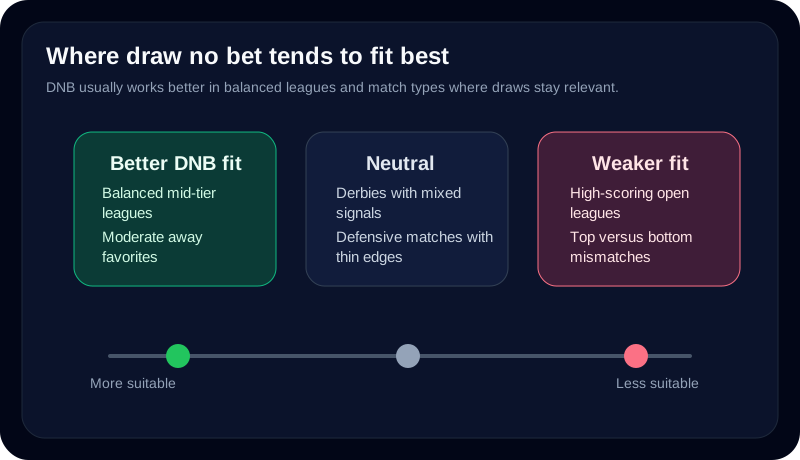 Which league and match profiles usually make draw no bet more useful.
Where to focus
- Matches where the teams are close in quality.
- Odds that reflect uncertainty rather than dominance.
- Tactical setups that suggest low scoring.
- Competitions with consistently high draw rates.
Situations to avoid
- High-tempo leagues with open play and high xG.
- Matches involving elite attacks against weak defences.
- Must-win scenarios that increase aggression.
What to check first
Before selecting a DNB based on league context:
- Is the league draw rate above average?
- Do teams play with tactical restraint?
- Is the match likely to be decided by small margins?
- Are the odds reflecting competitiveness rather than dominance?
League context works best as a pre-filter. It stops the market from being forced in structurally weak environments.
Using form and xG to evaluate draw no bet selections
Form and expected goals are two of the most useful inputs when assessing this market, but only when they are interpreted properly.
The goal is to identify teams that:
- Perform consistently.
- Control matches.
- Avoid defeat more often than the results alone suggest.
Recent form vs underlying performance
| Metric | What It Shows | Relevance for DNB |
|---|---|---|
| Points over last 5 | Short-term results | Limited alone |
| Win draw loss split | Outcome distribution | High |
| xG For | Chance creation quality | High |
| xG Against | Defensive stability | Very high |
| xG Difference | Overall performance level | Critical |
Form without context can be misleading. A team may:
- Win multiple games with low xG, which is often unsustainable.
- Draw frequently despite strong performances, which can create value.
Example of form vs xG interpretation
| Team | Last 5 Results | Points | Average xG | Average xGA | xG Diff |
|---|---|---|---|---|---|
| Team A | D D W D L | 6 | 1.60 | 0.90 | +0.70 |
| Team B | W W L W L | 9 | 1.10 | 1.30 | -0.20 |
Team B has better results, but Team A has much stronger underlying performance.
For DNB, Team A is often the better selection because:
- Loss risk is lower.
- Control metrics are stronger.
- The probability of avoiding defeat is higher.
Key xG patterns that support DNB
- Positive xG difference across multiple matches.
- Consistently low xGA.
- Stable chance creation rather than isolated spikes.
These indicators usually point to teams that are structurally sound and less likely to lose over time. That matters more in DNB than explosive upside, because this market rewards baseline reliability rather than peak performance.
Warning signs in form data
Be cautious with:
- Winning streaks supported by low xG.
- High shot conversion runs.
- Teams conceding high xGA but still scraping wins.
- Late goals that hide poor overall performance.
Practical evaluation checklist
Before selecting a DNB using form and xG:
- Does the team's xG support its recent results?
- Are draws masking strong performances?
- Is defensive consistency present?
- Is the opponent overperforming relative to xG?
Combining form and xG effectively
| Scenario | DNB Decision |
|---|---|
| Strong xG plus weak results | Positive |
| Weak xG plus strong results | Negative |
| Balanced xG plus high draw frequency | Positive |
| Volatile xG swings | Avoid |
The most reliable edge usually comes from spotting misalignment between performance and results, then backing the more stable team profile.
Key risks to review before placing a draw no bet bet
This market removes one specific risk, the draw, but it does not remove the wider uncertainty of football.
Many bettors overestimate the safety of DNB and ignore the structural risks that still remain.
Core risk categories
| Risk Type | Impact on DNB | Explanation |
|---|---|---|
| Overpriced odds | High | Lower odds can remove value |
| Misjudged draw probability | High | Wrong assumptions distort pricing |
| Team volatility | High | Unstable teams increase loss risk |
| Tactical mismatch | Medium to high | Styles can override form |
| External factors | Medium | Injuries and motivation still matter |
Even with draw protection, a poor read on these factors still creates negative expected value.
Pricing risk and the most common issue
The biggest hidden danger is accepting reduced odds without enough compensation.
Bookmakers often:
- Inflate margin in DNB markets.
- Exploit the perception of safety.
Bettors often:
- Accept lower odds too quickly.
- Fail to compare with adjusted probabilities.
Match context risks
| Scenario | Risk Level | Why It Matters |
|---|---|---|
| High-scoring match expected | High | Draw probability falls |
| One-sided tactical matchup | High | Loss risk increases |
| Must-win situation | Medium to high | Fewer draws and more chaos |
| Rotation or fatigue | Medium | Predictability drops |
DNB relies on a balanced probability structure. When matches become too open or too one-sided, the edge disappears.
Team-specific risk factors
Team-specific risks usually become dangerous when a side depends too heavily on one player, shows defensive inconsistency, or carries poor away performance into a tough fixture. High variance in recent results matters for the same reason. All of these signals raise the chance of an outright defeat, which is the one outcome DNB does not protect against.
Key red flags checklist
Before placing a DNB, the better question is whether the protection is hiding a bad team context. If the price is too short, the team still looks capable of losing clearly, or the match setup points toward a decisive result, the refund condition does not solve the core problem.
- Is the price lower than it should be?
- Is the team still capable of losing clearly?
- Does the match environment favor decisive outcomes?
- Are recent results masking instability?
If several answers are worrying, the bet is usually better avoided.
Risk vs reward balance
| Profile Type | Outcome Pattern | Long-Term Result |
|---|---|---|
| High hit rate and low odds | Frequent small wins | Often unprofitable |
| Balanced pricing | Moderate win rate | More sustainable |
| Overvalued safe bets | Illusion of control | Negative EV |
The goal is not to maximize win percentage. It is to optimize expected value relative to risk.
Common draw no bet mistakes that cost value
This market is often misunderstood because it feels safer than it really is. Most mistakes come from confusing risk reduction with value creation.
Avoiding these errors is just as important as finding good opportunities.
Most frequent betting mistakes
- Treating DNB as a safe bet by default.
- Ignoring price versus probability.
- Overusing DNB in low-draw matches.
- Backing teams that win often but also lose often.
- Relying on recent results instead of underlying performance.
These patterns often create high hit rates with weak long-term returns.
Mistake impact breakdown
| Mistake | Short-Term Effect | Long-Term Consequence |
|---|---|---|
| Overvaluing safety | Higher win rate | Lower ROI |
| Ignoring implied probability | Faster decisions | Negative EV |
| Misreading team profiles | Occasional wins | Inconsistent results |
| Using DNB in wrong match types | Reduced variance | Missed value |
| Chasing stability over edge | Emotional comfort | Profit erosion |
The false security problem
One of the biggest traps is believing that a draw refund automatically makes the bet good.
That ignores two critical points:
- You are paying for that protection through lower odds.
- The loss outcome still exists and must be evaluated properly.
If the team still has a real chance of losing, DNB does not solve the core risk.
Misuse of market context
| Incorrect Assumption | Reality |
|---|---|
| Close match means always use DNB | Only if pricing supports it |
| Favorite means DNB is safer | Often overpriced |
| Draw likely means automatic value | Usually already priced in |
| Lower odds means lower risk | Not always true |
Markets already adjust for draw probability. Value exists only when that adjustment is inaccurate.
Behavioral errors
- Preferring comfort over expected value.
- Avoiding losses psychologically rather than mathematically.
- Repeating the same market regardless of match context.
These behaviors create consistent but inefficient betting patterns.
How to correct the usual mistakes
Before placing a DNB, ask:
- Am I choosing this market because it feels comfortable or because it is priced well?
- Does the team profile support a low loss probability?
- Is the draw actually meaningful in this specific match?
- Would 1X2 offer better value here?
DNB becomes effective only when it is used selectively, supported by data, and compared rigorously against alternatives.
A practical framework for choosing draw no bet bets
A structured approach is essential if this market is going to work over time. Without a repeatable process, decisions become inconsistent and driven by perception rather than probability.
The goal is to standardize selection criteria so every bet is based on measurable edge.
Step-by-step decision framework
| Step | Evaluation Area | Key Question |
|---|---|---|
| 1 | Match context | Is this a balanced or moderately competitive match |
| 2 | Draw probability | Is the draw realistically in the 20 to 30 percent range |
| 3 | Team profile | Does the selected team avoid defeat consistently |
| 4 | xG and performance data | Do underlying stats support the selection |
| 5 | Odds and implied probability | Is there a measurable pricing edge |
| 6 | Market comparison | Is DNB better than 1X2 or double chance here |
Each step removes weak bets and leaves only qualified scenarios.
Match qualification criteria
A match should pass most of these filters:
- Teams are relatively close in strength.
- There is no extreme attacking or defensive mismatch.
- Tactical setup suggests controlled tempo.
- Odds reflect uncertainty rather than dominance.
If those conditions are missing, DNB is usually not the best market.
Team selection criteria
| Factor | Requirement |
|---|---|
| Loss rate | Low, ideally under 25 to 30 percent |
| Defensive metrics such as xGA | Stable and below average |
| xG difference | Positive or improving |
| Consistency | Low variance in performance |
This helps ensure the team is more likely to avoid defeat and is not relying on high-variance outcomes.
Pricing validation process
- Convert odds into implied probability.
- Adjust probabilities by removing the draw.
- Compare your estimate against bookmaker pricing.
The minimum requirement is a small but clear edge.
Market selection decision
| Scenario | Best Market |
|---|---|
| Clear dominance and low draw risk | 1X2 |
| Balanced match and moderate draw risk | DNB |
| Very high uncertainty and low confidence | Double chance or no bet |
This step prevents forcing DNB when another market offers better value.
Risk classification approach
In probability-based systems, DNB bets are usually treated as:
- Medium risk with controlled variance.
- Not low risk unless pricing is clearly favorable.
- Not high value unless a probability edge exists.
Final pre-bet checklist
Before placing a DNB wager:
- Does the team have a low probability of losing?
- Is the draw meaningful in this match?
- Are the odds aligned with your probability estimate?
- Is DNB clearly better than alternative markets?
If any of those answers are unclear, the best decision is often no bet.
What a disciplined DNB process looks like
Draw no bet works best when:
- It is applied selectively.
- It is driven by probability rather than perception.
- It is compared against other markets every time.
The edge does not come from the market itself. It comes from how and when it is used.
Conclusion
Draw no bet in football betting is best understood as a risk-adjusted pricing tool rather than a shortcut to safer betting. Its effectiveness depends entirely on context, especially match balance, team profile, and the relationship between odds and true probability.
The market performs best in competitive fixtures where:
- One team shows structural superiority.
- The draw remains a realistic outcome.
- Pricing does not fully reflect that balance.
At the same time, reduced odds mean poor selections quickly erode long-term profitability.
A disciplined approach requires:
- Evaluating team stability over raw win rates.
- Using xG and performance data to find hidden edges.
- Comparing DNB against 1X2 and double chance every time.
- Accepting that many matches will not qualify.
Ultimately, draw no bet is neither inherently safe nor inherently valuable. Its strength lies in selective, probability-based application where risk control and pricing efficiency align.