
Double Chance Betting in Football for Smarter Low Risk Picks
A data-driven guide to double chance betting in football. Learn when it offers value, how to assess odds, and how to build a disciplined betting strategy.
In this article
- What double chance actually means
- The three double chance options and what they cover
- When double chance actually makes sense
- Team strength, matchup style, and double chance value
- Is home and away form the key signal
- Draw rates and goal trends behind strong double chance picks
- Double chance odds implied probability and hidden market risk
- Double chance vs draw no bet and Asian handicap
- Common errors that reduce long-term value
- How to build a disciplined double chance strategy
Double chance is one of the most commonly used football markets among risk-conscious bettors because it lets you cover two of the three possible match outcomes.
That lower variance can be useful, but it does not automatically create value. In many matches the market is priced efficiently enough that the added protection only makes the odds too short.
Double chance becomes useful only when probability is underestimated, not simply when the bet feels safer.
This is easiest to understand when you compare it directly with draw no bet football betting, Asian handicap football betting, and the live best football tips today shortlist. Those pages show where the extra protection helps and where it simply makes the price too short.
Start here
Football Betting Strategy for Smarter Long Term Decisions
This guide sits inside a wider topic path. Read the core concept first if you want the parent framework before the deeper market detail.
Read the core conceptWhat double chance actually means
Double chance betting allows you to cover two match outcomes in a single bet:
- Home win or draw with
1X. - Away win or draw with
X2. - Either team to win with
12, which removes the draw.
This reduces risk, but it also lowers potential returns.
Core structure of double chance bets
| Option | Covers Outcomes | When It Wins | Risk Level |
|---|---|---|---|
| 1X | Home or draw | Home win or draw | Low |
| X2 | Away or draw | Away win or draw | Low |
| 12 | Either team wins | Any result except a draw | Medium |
From a betting perspective, this market is not really about predicting winners. It is about eliminating one outcome on probability grounds.
The most common use case is backing underdogs not to lose with X2 or supporting strong home teams with draw protection through 1X.
Unlike outright betting, the goal is not precision. It is probability coverage. That makes the market especially relevant in matches where:
- The favorite is not dominant.
- The underdog is defensively stable.
- The draw probability is above average.
Because of that, double chance works best as a risk-management tool rather than a strategy on its own.
The three double chance options and what they cover
Understanding the structure of this market matters because each option reflects a different risk profile and a different match hypothesis.
All three reduce uncertainty compared with a standard 1X2 bet, but they are not interchangeable.
Double chance options breakdown
| Option | Covers | Typical Use Case | Key Risk |
|---|---|---|---|
| 1X | Home win or draw | Strong home side, but not dominant | Underrating away threat |
| X2 | Away win or draw | Competitive underdog or balanced matchup | Weak away form |
| 12 | Either team wins | Matches unlikely to finish level | Unexpected stalemate |
1X and home advantage with draw protection
This is the most common double chance option. It assumes the home team is unlikely to lose, even if it is not reliable enough to win outright.
This usually works best when:
- The home team has a consistent defensive structure.
- The away team struggles offensively.
- The home side has moderate win probability but low loss probability.
Pricing is usually tight here, so value only exists if the draw probability is being underestimated.
X2 and backing the underdog not to lose
The X2 option is often more interesting from a value perspective. It lets you support an underdog that looks capable of avoiding defeat.
That becomes relevant when:
- The favorite is overvalued by the market.
- The underdog has strong defensive numbers or efficient counters.
- Recent form suggests balance rather than real dominance.
X2 is not about predicting an upset. It is about identifying matches where the favorite is less reliable than the odds imply.
12 and removing the draw
This version is structurally different. Instead of backing stability, it assumes the match will produce a winner.
It fits best when:
- Both teams play high-tempo or attacking football.
- Historical data shows low draw frequency.
- Goal expectation is relatively high.
The risk shifts completely onto the draw, which is still a common outcome in football.
Key decision factors when choosing between options
When selecting the right variation, focus on:
- Match balance and whether one team is clearly stronger.
- Draw probability and whether the game projects as tight or open.
- Team consistency in avoiding defeat.
- Game-state patterns such as protecting leads or collapsing late.
How to use each option
- Use
1Xwhen the home team is stable but not dominant. - Use
X2when the underdog is more competitive than the odds imply. - Use
12when the data points strongly toward a decisive result.
TipSignal next step
Apply it on the safer shortlist
See how the stronger, lower-variance selections are filtered once price, probability, and shortlist quality are judged together.
See today's best football tipsWhen double chance actually makes sense
Double chance only becomes strategically useful in specific match conditions. It is not a default safe option. It is a selective tool that works best when uncertainty is high but skewed away from one outcome.
The aim is to identify matches where one result is unlikely rather than trying to predict the exact scoreline.
Match profiles where double chance adds value
| Match Type | Why Double Chance Works | Preferred Option | Risk Level |
|---|---|---|---|
| Strong home team vs resilient opponent | Home rarely loses, but draws are common | 1X | Low |
| Overvalued favorite vs competitive underdog | Market overestimates favorite dominance | X2 | Medium |
| Evenly matched teams | Draw probability is high | 1X or X2 | Medium |
| High-variance matches | Outcomes unclear, but one side unlikely to win | Depends on angle | Medium |
| Attack-heavy teams with low draw rates | Draw is less likely | 12 | Medium |
Key conditions that justify double chance use
Double chance is worth considering when two or more of these factors are present:
- The favorite shows inconsistent performance levels.
- The underdog has defensive stability or strong structure.
- The match has moderate or high draw probability.
- There is repeated evidence of close scorelines.
- The odds suggest too much confidence in one outcome.
These conditions suggest that eliminating one result improves the probability edge.
Why safer does not always mean better
A common mistake is assuming double chance is automatically a good bet because it lowers risk.
In reality:
- Bookmakers shorten the odds aggressively.
- Margin is often higher in double chance markets.
- Many bets win frequently without offering any real expected value.
Identifying value vs low-risk traps
| Scenario | Appears Safe | Actually Valuable | Reason |
|---|---|---|---|
| Top team at home at very low odds | Yes | Rarely | Price already reflects low loss probability |
| Mid-table clash with 1X or X2 | Moderate | Often | Draw probability is undervalued |
| Underdog with strong recent form on X2 | No | Often | Market can be slow to adjust |
| High-scoring teams on 12 | Moderate | Conditional | Depends on true draw probability |
Practical indicators of a good double chance opportunity
Focus on measurable signals rather than intuition:
- The xG gap is small even if the odds suggest otherwise.
- The underdog has a low loss rate even if wins are rare.
- The favorite struggles against compact defensive setups.
- Match importance increases caution.
- Both teams show consistent draw patterns.
Double chance should be used only when it improves probability relative to price, not simply to reduce variance.
Team strength, matchup style, and double chance value
Team strength and tactical matchup matter far more here than surface-level form or league position.
The key distinction is simple. You are not betting on who wins. You are betting on who is unlikely to lose.
Comparing team strength beyond league position
League tables often distort real performance levels. A higher-ranked team may still be vulnerable in the wrong tactical matchup.
| Factor | Strong Favorite | Competitive Underdog | Betting Impact |
|---|---|---|---|
| xG difference | High positive | Slight negative or balanced | Smaller gap favors double chance |
| Chance creation | Consistent | Moderate but efficient | Supports X2 potential |
| Defensive stability | Average | Strong structure | Reduces loss probability |
| Conversion rate | High but volatile | Lower but steady | Increases draw likelihood |
When the statistical gap is narrower than the odds suggest, double chance becomes much more attractive, especially on X2.
Tactical matchups that favor double chance
Certain styles naturally reduce the likelihood of one-sided outcomes:
- Possession-heavy sides against compact low blocks.
- Counter-attacking underdogs against favorites that leave space.
- Physical or defensive leagues where tempo and chance volume stay low.
These dynamics often compress the real gap between the teams and make outright win markets less reliable.
Identifying difficult-to-beat teams
Some teams rarely win but are consistently hard to defeat. Those are ideal candidates for double chance markets.
Key indicators include:
- A low loss percentage relative to league average.
- Frequent draws against stronger opponents.
- Organized defensive shape and lower xGA.
- The ability to control tempo when the match is level.
Matchup risk assessment framework
| Scenario | Double Chance Fit | Reasoning |
|---|---|---|
| Top team vs open attacking opponent | Weak | High volatility favors outright markets |
| Top team vs compact defensive side | Strong | Draw probability rises |
| Mid-table vs mid-table | Strong | Balanced strength creates uncertainty |
| Underdog vs inconsistent favorite | Strong | Market often overprices the favorite |
| Two defensive teams | Moderate | Depends on goal expectation |
Key analytical signals to prioritize
When evaluating team strength and matchup style, focus on:
- xG versus actual results.
- Game-control metrics beyond possession.
- Shot quality allowed through xGA.
- Performance against similar-level opponents.
- In-game patterns such as late collapses or defensive stability.
Double chance value appears when tactical interaction shrinks the true gap between teams, even if the market is still pricing them far apart.
Is home and away form the key signal
Home and away performance is one of the most influential inputs in this market, but it is often misread.
For double chance betting, the real focus should be on how often a team avoids defeat in a specific environment, not just how often it wins.
Home vs away performance breakdown
| Metric | Strong Home Team | Weak Away Team | Double Chance Impact |
|---|---|---|---|
| Home loss rate | Low | — | Supports 1X |
| Away loss rate | — | High | Supports 1X |
| Home draw rate | Moderate | — | Strengthens 1X value |
| Away draw rate | — | Moderate | Strengthens X2 value |
| Goals conceded | Low | High | Reduces upset risk |
The most important variable is not wins. It is how often a team avoids defeat in that specific setting.
Why home advantage still matters
Home advantage remains relevant because of:
- Familiar tactical setup and pitch conditions.
- Reduced travel fatigue.
- Historical referee bias trends.
- More controlled game tempo.
For double chance markets, home teams with low loss rates are especially useful for 1X, even when they draw often.
Away teams as risk or opportunity
Away form is often undervalued, especially when the underdog is tactically built to survive pressure.
Some away teams are:
- Compact and counter-focused.
- More effective without possession.
- Comfortable playing for draws.
Those profiles are often stronger for X2 than the market expects.
Key home and away patterns to target
- A home team that rarely loses but often draws.
- An away team that rarely wins but often avoids defeat.
- A favorite with a strong home record that still struggles against defensive setups.
- An underdog that performs better away because of tactical style.
Red flags bettors often miss
Even strong venue trends can mislead when:
- The home record was built against weak opposition.
- Away resilience was inflated by low-quality chances faced.
- Recent form masks long-term inconsistency.
- The sample size is too small.
Home vs away decision framework
| Scenario | Recommended Bet | Reasoning |
|---|---|---|
| Strong home team with low loss rate | 1X | Stability at home reduces downside |
| Underdog with solid away structure | X2 | Can absorb pressure and avoid defeat |
| Two inconsistent teams | 1X or X2 depending on context | Draw likelihood rises |
| Dominant home favorite vs weak away side | Avoid double chance | Odds too low for value |
Home and away form is useful only when it is interpreted through loss probability and matchup context rather than raw results.
Draw rates and goal trends behind strong double chance picks
Draw probability is one of the most important and most underestimated parts of this market. Since 1X and X2 both include the draw, understanding which matches are structurally likely to finish level is essential.
At the same time, goal trends help determine whether the match environment supports or reduces draw likelihood.
Draw rates vs goal environment
| Match Type | Average Goals | Draw Probability | Double Chance Fit |
|---|---|---|---|
| Low-scoring at 2.2 or less | Low | High | Strong for 1X and X2 |
| Balanced scoring at 2.2 to 2.8 | Medium | Moderate | Conditional |
| High-scoring at 2.8 or more | High | Low | Weak except for 12 |
| Defensive vs defensive | Low | Very high | Strong |
| Attack vs attack | High | Low | Better for 12 |
As expected goals rise, draw probability usually falls.
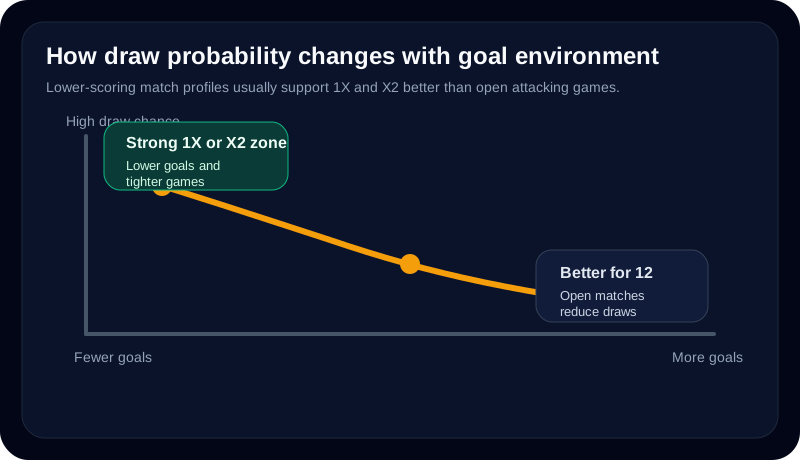 Draw rates usually fall as goal expectation rises.
Why draws matter more than wins
In traditional betting, the draw is often treated as a secondary outcome. In double chance markets it is central to profitability.
A strong double chance pick usually includes:
- A team that is unlikely to lose.
- A match with elevated draw probability.
That overlap is what raises the success rate relative to the odds.
Identifying high draw probability matches
Focus on these measurable indicators:
- Similar xG and xGA profiles.
- Little gap in shots on target per match.
- Teams that struggle with chance conversion.
- Frequent 1 to 1 and 0 to 0 scorelines.
- Tactical setups that emphasize defensive shape.
Goal-based indicators that support double chance
| Metric | Signal | Betting Interpretation |
|---|---|---|
| Combined xG under 2.4 | Low scoring | Higher draw likelihood |
| Both teams scoring rate at 45 to 60% | Balanced | Supports 1X and X2 |
| High clean sheet frequency | Defensive strength | Reduces decisive outcomes |
| Low big chances created | Limited attacking threat | Favors tight matches |
When goal trends reduce double chance value
Double chance becomes less effective in matches with:
- High xG totals.
- Teams with strong conversion rates.
- Frequent multi-goal margins.
- Tactical setups built around aggressive pressing and transitions.
Those environments are more likely to produce a clear winner, which often makes 12 or another market more suitable.
Practical betting filters
Use this checklist before placing a double chance bet:
- Is expected total goals below league average?
- Do both teams show similar attacking output?
- Are draws common in recent and historical matches?
- Is there no clear tactical dominance?
If the answer is yes to most of these, the structure of the match usually fits double chance well.
Double chance odds implied probability and hidden market risk
Understanding the price is where most strategies either gain an edge or quietly lose money over time.
This market looks safer, but the pricing often removes value unless it is analyzed carefully.
Converting odds to implied probability
| Odds | Implied Probability | Interpretation |
|---|---|---|
| 1.20 | 83.3% | Very high likelihood, low return |
| 1.30 | 76.9% | Strong favorite coverage |
| 1.50 | 66.7% | Moderate probability |
| 1.70 | 58.8% | Balanced risk and reward |
| 2.00 | 50.0% | Even probability |
Because you are covering two outcomes, the odds are naturally compressed. That means:
- You need a very high true probability to justify short odds.
- Small errors in estimation can wipe out long-term profitability.
Why double chance markets are often overpriced
These markets can hide inefficiencies because:
- They are built by combining two outcomes, which compounds margin.
- Recreational bettors favor safer-looking bets, which inflates demand.
- Popular favorites are overrepresented in
1Xselections.
That leads to situations where the bet wins often but still has negative expected value.
Odds vs true probability comparison
| Scenario | Market Probability | Estimated True Probability | Value |
|---|---|---|---|
| 1X on strong home team | 80% | 78% | Negative |
| X2 on competitive underdog | 60% | 65% | Positive |
| 12 in high-scoring match | 70% | 72% | Slight value |
| 1X on overvalued favorite | 85% | 80% | Negative |
The objective is to find positive gaps, not just high-probability outcomes.
Identifying hidden risk in safe-looking bets
Many double chance bets look reliable but still carry structural risk:
- Late goals turning draws into losses.
- Overreliance on historical home advantage.
- Ignoring tactical changes in the specific matchup.
- Backing teams with inconsistent defensive performance.
Margin awareness in double chance betting
| Market Type | Typical Margin Impact | Value Potential |
|---|---|---|
| 1X2 match result | Standard | Moderate |
| Double chance | Slightly higher | Lower unless mispriced |
| Asian handicap | Lower margin | Often better value |
| Draw no bet | Moderate | Situational |
This is why experienced bettors compare double chance with alternative markets rather than treating it as automatic.
Practical pricing checklist
Before placing a bet, evaluate:
- Does the implied probability match the data-driven estimate?
- Is the favorite overpriced because of reputation?
- Would another market offer better value for similar risk?
- Is the price simply too low to justify variance?
Double chance only works when the odds underestimate the true probability, not when the selection just feels safer.
Double chance vs draw no bet and Asian handicap
Choosing the right market is often more important than choosing the right team.
Double chance is useful, but it is not always the most efficient way to express a prediction. In many matches draw no bet or Asian handicap will price the same idea better.
Core market comparison
| Market | Covers | Risk Level | Odds Value | Best Use Case |
|---|---|---|---|---|
| Double chance | Two outcomes | Low | Lower | Avoiding one outcome |
| Draw no bet | Win only, refund on draw | Medium | Better | Slight edge on one team |
| Asian handicap | Spread-based | Flexible | Often best | More precise probability targeting |
Double chance vs draw no bet
These two markets are closely related, but they reflect different intentions.
| Factor | Double Chance | Draw No Bet |
|---|---|---|
| Draw outcome | Win | Refund |
| Risk | Lower | Moderate |
| Odds | Lower | Higher |
| Use case | Avoid defeat | Back a team with a slight edge |
Use double chance when you believe a team is unlikely to lose. Use draw no bet when you believe a team is more likely to win than lose.
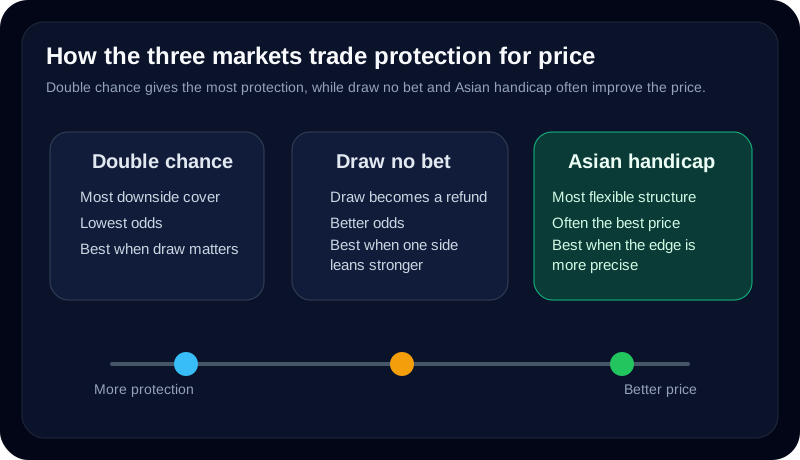 Double chance protects against defeat, while draw no bet pays more when your edge is stronger.
Double chance vs Asian handicap
Asian handicap gives more precise control over price and risk.
| Scenario | Double Chance | Asian Handicap Alternative | Why AH May Be Better |
|---|---|---|---|
| 1X home or draw | Covers two outcomes | AH 0 or -0.5 | Better odds when confidence is stronger |
| X2 away or draw | Covers two outcomes | AH +0.5 | Often similar protection with better pricing |
| 12 no draw | Covers wins only | AH plus or minus 0.5 lines | More flexibility |
Asian handicap lets you:
- Fine-tune risk exposure.
- Avoid paying for unnecessary coverage.
- Target a more precise edge.
When double chance is not the best option
Double chance becomes inefficient when:
- The odds are too low to justify the protection.
- You have a clear directional edge.
- Asian handicap offers similar protection at a better price.
Market selection decision framework
Use this approach:
- Choose double chance when you want to eliminate one outcome and draw probability matters.
- Choose draw no bet when you slightly favor one side and want better odds than double chance.
- Choose Asian handicap when pricing efficiency matters most and the edge can be quantified more precisely.
Practical comparison example
| Scenario | Best Market | Reason |
|---|---|---|
| Balanced teams with high draw chance | Double chance | Covers key outcomes |
| Slightly stronger home team | Draw no bet | Better value with protection |
| Underdog underestimated by market | AH +0.5 | Similar protection, better odds |
| Strong favorite with clear edge | AH -1 or moneyline | Double chance is overpriced |
Smart market selection is about matching the bet type to the edge, not automatically choosing the safest-looking option.
Common errors that reduce long-term value
This market is often misused because it feels safer than it really is.
Many bettors focus on hit rate rather than expected value, which leads to bets that win often but lose money slowly over time.
Most frequent double chance mistakes
- Overusing double chance in low-value spots.
- Backing strong favorites at very short odds.
- Ignoring true probability versus implied probability.
- Treating double chance as a default strategy.
- Failing to compare with Asian handicap alternatives.
These mistakes usually produce high win rates with poor returns.
The safe bet illusion
One of the biggest misconceptions is that reduced risk justifies almost any price.
| Scenario | Win Rate | Long-Term Value | Problem |
|---|---|---|---|
| 1X on dominant home team | Very high | Negative | Odds too low |
| X2 on weak underdog | Low | Negative | Poor team selection |
| Balanced matchup with correct use | Moderate | Positive | Proper context |
The issue is not whether the bet wins. It is whether the price reflects the real probability.
Ignoring price efficiency
Many bettors choose double chance without asking:
- Are the odds compressed because of market demand?
- Could the same prediction be expressed more efficiently elsewhere?
- Is the bookmaker margin too high to overcome?
That leads to overpaying for safety again and again.
Misreading team strength
Another common error is relying on:
- League position instead of xG or xGA.
- Recent wins instead of loss-avoidance patterns.
- Reputation instead of current tactical effectiveness.
Poor match selection
| Bad Selection Type | Why It Fails | Better Approach |
|---|---|---|
| Heavy favorite vs weak team | Odds too low | Avoid or use handicap |
| High-scoring match | Low draw probability | Consider 12 or goals market |
| Unpredictable teams | High variance | Avoid entirely |
| Strong vs strong but mispriced | Overconfidence in one side | Use X2 or 1X selectively |
Double chance works best in controlled and relatively predictable match environments, not chaotic ones.
Overlooking variance in football
Even with two outcomes covered:
- A single goal can invalidate the bet.
- Late-game volatility remains high.
- Red cards, penalties, and tactical shifts still create unpredictability.
Double chance is lower variance, not low variance.
Practical error-avoidance checklist
Before placing a bet, ask:
- Is this based on probability or just safety perception?
- Are the odds offering real value or just high likelihood?
- Is this the best market for this prediction?
- Does the match fit a lower-variance profile?
If several answers are unclear, the best decision is often to skip the bet.
How to build a disciplined double chance strategy
A sustainable approach is not built on finding safe bets. It is built on consistent decision rules around probability, price, and match context.
The objective is not to maximize win rate. It is to improve long-term expected value while keeping variance under control.
Core components of a structured strategy
| Component | Purpose | Impact on Results |
|---|---|---|
| Match selection | Filter suitable fixtures | Reduces unnecessary risk |
| Probability estimation | Assess true outcome likelihood | Identifies value |
| Odds evaluation | Compare against implied probability | Avoids overpaying |
| Market selection | Choose the best format | Improves efficiency |
| Risk classification | Categorize bet types | Maintains discipline |
Skipping any one of these usually leads to inconsistent results.
Step-by-step decision framework
Use this process before placing a double chance bet:
- Start with match filtering and avoid high-variance games.
- Estimate true probabilities using xG, draw rates, and team strength indicators.
- Select the correct double chance option based on the match hypothesis.
- Compare the odds with the probability estimate.
- Check alternative markets such as Asian handicap or draw no bet.
Risk-based classification model
| Category | Criteria | Example Scenario | Strategy Use |
|---|---|---|---|
| Low risk | High probability and low variance | Strong home team rarely loses | 1X |
| Controlled value | Market underestimates the underdog | Competitive away team | X2 |
| Medium risk | Outcome uncertainty but predictable structure | High-tempo match with low draw chance | 12 |
This kind of classification helps maintain consistency across different match types.
Bankroll and stake management
Even with strong analysis, variance remains part of football betting. A disciplined strategy should include:
- Fixed stake percentage per bet, such as 1 to 3 percent.
- No stake increases after losses.
- Limited exposure to similar match types to avoid correlation risk.
The goal is survival through variance, not short-term gains.
Key strategic rules to follow
- Only place a bet when probability is above implied probability.
- Avoid very short odds unless there is a clear edge.
- Do not combine double chance bets in accumulators just for safety.
- Track performance separately for 1X, X2, and 12.
Performance tracking framework
| Metric | Why It Matters |
|---|---|
| Win rate | Measures consistency, not profitability |
| Average odds | Indicates pricing quality |
| ROI | Shows true performance |
| Market-type split | Reveals which options are effective |
| Closing line value | Shows whether the market was beaten |
When to avoid double chance entirely
A disciplined strategy also means knowing when not to use this market:
- When odds are too low to justify variance.
- When one team has clear dominance and another market expresses it better.
- When match volatility is high and unpredictable.
- When no clear probability edge exists.
What a disciplined process looks like
Double chance works best when:
- The match has controlled uncertainty.
- One outcome can be logically eliminated.
- The odds still underestimate the true probability.
It becomes ineffective when used as a default safety tool without pricing discipline.
Long-term success depends much less on the market itself and much more on how selectively and analytically it is applied.
Conclusion
Double chance betting in football is often misunderstood as a low-risk shortcut to steady results. In reality, it is a precision tool that becomes useful only in the right context.
The strongest opportunities usually come from matches where:
- Team strength is balanced or mispriced.
- Draw probability is meaningful.
- One outcome can be logically excluded.
- Odds do not fully reflect the true probability.
At the same time, many double chance bets fail not because the idea is wrong, but because the price does not justify the risk.
A disciplined approach based on probability, match structure, and market comparison makes the market useful without over-relying on it.