
Asian Handicap Football Betting for Better Margin Reading
Asian handicap football betting explained with data-driven strategy, margin analysis, and risk management to help you make smarter betting decisions.
In this article
- What Asian handicap actually asks you to predict
- How Asian handicap lines change the way a match is priced
- How to read full half and quarter goal lines without confusion
- What the line says about team strength
- Why home and away data matter more than they seem
- Goal margin profiles that shape handicap results
- Can expected goals improve handicap decisions
- Odds implied probability and line movement in Asian handicap markets
- Squad news motivation and scheduling pressure before you bet
- Building a safer Asian handicap framework
Asian handicap betting is fundamentally about goal margins rather than match outcomes alone. Unlike traditional 1X2 betting, this market adjusts the scoreline to reflect perceived team strength, which removes or reduces the draw and creates more precise pricing.
For bettors, that means decisions should be based on how teams win or lose, not simply whether they do. A team that regularly wins by one goal behaves very differently from one that consistently dominates by two or more.
Asian handicap value usually comes from misjudged margins rather than misjudged winners.
If you want to compare margin betting with the softer protection markets, read double chance betting in football and draw no bet football betting alongside this guide. It also pairs naturally with high-odds football tips, where line strength and price discipline matter more than simple favorite picking.
Start here
Football Betting Strategy for Smarter Long Term Decisions
This guide sits inside a wider topic path. Read the core concept first if you want the parent framework before the deeper market detail.
Read the core conceptWhat Asian handicap actually asks you to predict
Asian handicap markets are built around the idea of leveling the playing field by assigning a virtual goal advantage or disadvantage before the match starts.
Instead of asking who will win, the real question becomes whether the adjusted scoreline will still favor your selection.
Core handicap logic
| Handicap | What Needs to Happen | Outcome Type |
|---|---|---|
| 0 | Team must win | Refund if draw |
| -0.5 | Team must win | No draw protection |
| -1.0 | Win by 2 or more | Push if win by 1 |
| +1.0 | Can lose by 1 | Push if lose by 1 |
| +0.5 | Win or draw | Higher probability |
This structure changes how probability is distributed.
What that means in practice
- Asian handicap reduces randomness from draws.
- Margins matter more than simple outcomes.
- Pricing becomes more precise than 1X2 markets.
- Smaller edges can be exploited with better modelling.
From a structured point of view, this market allows much clearer classification of bets based on expected margin versus implied margin.
How Asian handicap lines change the way a match is priced
Asian handicap markets are not just alternative bet types. They represent a more refined pricing model than traditional 1X2 odds.
Instead of pricing three outcomes, bookmakers are effectively pricing the expected goal difference between the two teams.
From match outcome to goal expectation
| Market Type | What Is Being Priced | Key Limitation |
|---|---|---|
| 1X2 | Match result | Draw introduces inefficiency |
| Asian handicap | Goal difference | Requires margin accuracy |
In 1X2 markets, two teams with similar win probabilities can still have very different margin profiles. Handicap markets try to price that difference more directly.
How bookmakers build the line
The line is usually shaped by:
- Team strength ratings.
- xG-based projections.
- Historical goal margins.
- Home and away adjustments.
- Market demand and liquidity.
That creates a baseline expectation such as:
- Strong favorite on
-1.25or-1.5. - Moderate favorite on
-0.5or-0.75. - Even match on
0or±0.25.
The line itself is the bookmaker's estimate of the true gap between the teams.
What the price is really saying
- The handicap is a probability statement about margin.
- The odds attached to the line determine whether the bet is positive EV.
- Small shifts such as
-0.75to-1.0can materially change risk exposure.
Where value typically appears
Value tends to emerge when:
- The market overreacts to recent scorelines.
- Underlying xG performance differs from results.
- Public betting pushes popular teams too far.
- Fatigue, rotation, or motivation are not fully priced.
What to focus on
- Treat the handicap as the bookmaker's margin prediction.
- Focus on whether that margin looks realistic based on data.
- Stop thinking in terms of the better team and start thinking in terms of the expected winning distance.
How to read full half and quarter goal lines without confusion
Understanding how different lines settle is essential because each one carries a different risk profile, even when the teams and odds look similar.
Misreading settlement mechanics is one of the easiest ways to make bad value decisions.
Settlement mechanics by line type
| Line Type | Example | Possible Outcomes | Risk Profile |
|---|---|---|---|
| Full goal | -1.0 | Win, push, or lose | Medium |
| Half goal | -0.5 | Win or lose only | Higher volatility |
| Quarter goal | -0.75 | Half win, half loss, or full win | Mixed risk |
These differences directly shape both variance and long-term expectation.
Full goal lines and built-in protection
Full-goal handicaps such as -1.0 or +1.0 include a push outcome, which lowers risk.
Example with Team A -1.0:
- Win by 2 or more means full win.
- Win by 1 means stake refunded.
- Draw or lose means loss.
That structure is often preferable in lower-confidence scenarios because it limits downside.
Half goal lines and no margin for error
Half-goal lines such as -0.5 and +0.5 remove the possibility of a push.
-0.5means the team must win.+0.5means the team can win or draw.
There is no safety buffer, which usually means:
- Higher variance.
- More decisive outcomes.
- Slightly higher odds.
Quarter goal lines and split-stake complexity
Quarter lines such as -0.25, -0.75, or +0.75 split the stake across two adjacent lines.
Example with Team A -0.75:
- Half the stake goes on
-0.5. - Half the stake goes on
-1.0.
The outcome changes depending on the winning margin:
| Result | Outcome |
|---|---|
| Win by 2 or more | Full win |
| Win by 1 | Half win |
| Draw or worse | Loss |
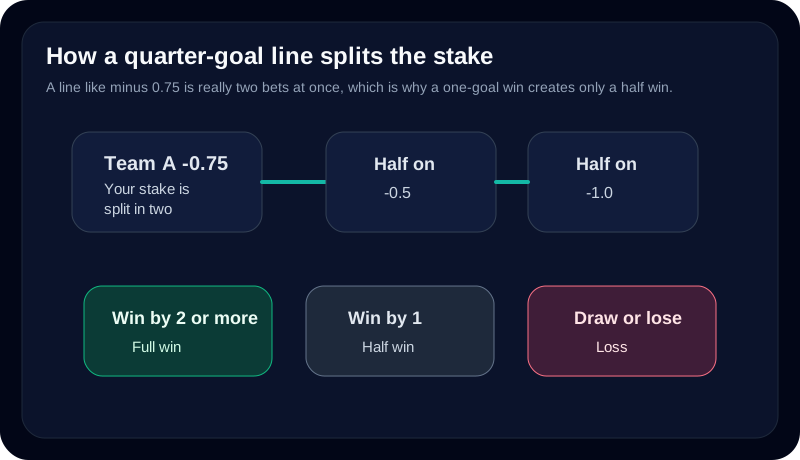 How quarter-goal settlement works.
Why this matters for betting decisions
Different line types should never be treated as identical, even when the same team is involved.
Key considerations:
- Quarter lines help when margin expectation sits between two lines.
- Full lines reduce volatility but can lower potential edge.
- Half lines increase volatility while simplifying the outcome.
How to choose between nearby lines
When choosing between adjacent lines, consider:
- Expected margin versus line position.
- Risk tolerance and variance exposure.
- Price difference between nearby lines.
- Likelihood of the key one-goal margin.
What matters most
- Not all handicap lines behave the same way.
- Quarter lines add flexibility but need precise understanding.
- Full lines offer protection while half lines increase volatility.
- Correct line selection matters as much as team selection.
TipSignal next step
Apply it on the value shortlist
See where bigger prices still hold up once implied probability, market edge, and variance are judged together.
Explore high-odds football tipsWhat the line says about team strength
An Asian handicap line is essentially the bookmaker's numerical interpretation of the strength difference between two teams.
It is not only saying who is better. It is estimating by how much that team should outperform the opponent.
Interpreting handicap levels as strength gaps
| Handicap Line | Implied Strength Gap | Typical Scenario |
|---|---|---|
| 0 | No clear gap | Evenly matched teams |
| -0.25 or -0.5 | Small edge | Slight favorite |
| -0.75 or -1.0 | Moderate gap | Stronger side expected to control |
| -1.25 or -1.5 | Clear superiority | Dominant favorite |
| -2.0 or more | Large mismatch | Elite team against weak opponent |
The larger the negative handicap, the more the market expects sustained dominance and multi-goal margins.
Why the better team narrative is not enough
A common mistake is assuming the better team will win, so the handicap must be justified.
That is incomplete. The real question is whether the strength gap is large enough to justify the assigned line.
For example:
- One team may win often but only by one-goal margins.
- Another may win less often but produce more multi-goal wins.
Those profiles behave very differently in handicap markets.
Key factors that define true strength gaps
When judging whether a line is accurate, consider:
- xG difference and chance control.
- Game control through territory and shot volume.
- Squad depth and rotation reliability.
- Consistency against similar-level opponents.
- Performance against defensive or attacking styles.
Strength gap vs market perception
| Scenario | Market Behavior | Potential Issue |
|---|---|---|
| Big-name team in good form | Line inflated | Overpricing risk |
| Underrated mid-table team | Line suppressed | Hidden value |
| Recent big win | Public overreaction | Short-term bias |
| Poor finishing run | Line discounted | Regression potential |
Markets are efficient, but they still react strongly to recent outcomes.
How to read the number
When you see a handicap like -1.25, it helps to translate it mentally as the market expecting that team to win by around one to two goals on average.
Your task is to decide whether that expectation is too high, too low, or fair.
What matters for decision-making
- Handicap lines reflect expected margin, not just superiority.
- A correct winner can still be a losing handicap bet.
- Value appears when the true performance gap differs from the market-implied gap.
- Overrated favorites are one of the most common sources of inefficiency.
Why home and away data matter more than they seem
Home and away performance is one of the most influential and most underestimated parts of handicap betting.
The line usually includes a built-in home advantage adjustment, but that adjustment is not equally accurate for every team.
Home vs away performance differences
| Metric | Home Team | Away Team |
|---|---|---|
| Average goals scored | Higher | Lower |
| Average goals conceded | Lower | Higher |
| Win rate | Stronger | Weaker |
| xG differential | Positive | Often reduced |
This general pattern is already priced in, but not always correctly for specific teams.
Why venue impacts handicap outcomes
Because Asian handicap is margin-focused, even small venue effects can change outcomes significantly.
Key reasons include:
- Tactical changes and more aggression at home.
- Crowd and referee influence.
- Travel fatigue for away teams.
- Familiarity with pitch and conditions.
- Differences in confidence and tempo.
Teams with extreme home and away splits
| Team Profile | Handicap Impact |
|---|---|
| Strong at home and weak away | Away favorites can become overvalued |
| Defensive away team | Covers positive handicaps more often |
| High pressing at home | More multi-goal wins |
| Passive away setup | Lower scoring margins |
Some teams consistently outperform expectations at home but cannot sustain the same level away.
Identifying mispriced situations
Look for scenarios where:
- A strong home team is priced too conservatively.
- A popular team is overvalued away from home.
- Defensive away teams get large positive handicaps in low-scoring environments.
- Travel-heavy schedules are missing from the price.
What to check before betting
Before placing a handicap bet, assess:
- Is the team's home performance significantly stronger than average?
- Does the away side lose attacking output on the road?
- Are recent results masking venue-specific trends?
- Has the market adjusted enough or too much for location?
What venue data really tells you
- Home advantage is real but not uniform.
- Handicap lines include venue bias but not always accurately.
- Goal margin shifts are often driven by location-specific performance.
- Away favorites remain one of the most common pricing traps.
Goal margin profiles that shape handicap results
In this market, goal margin distribution matters more than win rate.
Two teams with identical records can behave very differently depending on how they win and lose.
Win rate vs goal margin reality
| Team | Win Rate | Average Winning Margin | Handicap Performance |
|---|---|---|---|
| Team A | 65% | +0.9 goals | Weak on -1 lines |
| Team B | 60% | +1.6 goals | Strong on -1 lines |
| Team C | 50% | +0.3 goals | Better on plus handicaps |
| Team D | 45% | -1.5 goals | Poor even with plus lines |
A team that wins often by one goal will usually struggle to cover more aggressive lines such as -1.25 or -1.5.
Types of goal margin profiles
Different teams show different margin tendencies:
- Narrow-margin teams that win by one goal often.
- Dominant teams that regularly produce multi-goal victories.
- Volatile teams with big wins and big losses.
- Defensive teams that keep matches close and cover positive lines.
Margin distribution and betting impact
| Margin Outcome | Frequency Impact | Handicap Relevance |
|---|---|---|
| One-goal games | Very common | Critical for ±0.75 and ±1.0 lines |
| Two-goal wins | Less frequent | Required for larger handicaps |
| Draws | Moderate | Affects ±0.5 and level lines |
| Heavy losses | Rare for strong teams | Impacts +1.5 lines |
The one-goal margin is especially important because it often decides:
- Push versus win.
- Half win versus full win.
- Loss versus partial loss.
Identifying reliable margin patterns
To assess margin profile, analyze:
- Average goal difference per match.
- Percentage of wins by one goal versus two or more.
- Frequency of conceding multiple goals.
- Game-state behavior after taking the lead.
Common market misinterpretations
| Situation | Market Reaction | Reality |
|---|---|---|
| Team wins three straight games | Handicap increases | Wins may all be by one goal |
| High league position | Lines inflate | Margin dominance not proven |
| Big-name attack | Overvalued | Finishing may be inefficient |
| Defensive reputation | Undervalued | Positive handicaps can keep cashing |
How to use margin data
- Always separate win probability from margin probability.
- Be careful with favorites that rarely win by two or more.
- Look for teams with consistent multi-goal performances when laying bigger lines.
- Use margin data to choose between nearby handicaps.
What margin profiles reveal
- Goal margin profiles define long-term handicap success.
- Not all winning teams are good handicap teams.
- The one-goal margin is often the most important outcome in pricing.
- Margin tendencies improve both line selection and risk control.
Can expected goals improve handicap decisions
Expected goals is one of the most useful tools for evaluating this market because it focuses on chance quality and process rather than final scorelines.
Since handicap betting depends on margin expectation, knowing how many goals a team should score or concede gives a more stable foundation than results alone.
xG vs actual results
| Team | Average xG For | Average xG Against | Actual Goal Difference | Interpretation |
|---|---|---|---|---|
| Team A | 1.8 | 0.9 | +0.5 | Underperforming results |
| Team B | 1.2 | 1.4 | +0.3 | Overperforming results |
| Team C | 2.1 | 0.8 | +1.4 | Strong and sustainable |
| Team D | 0.9 | 1.6 | -0.2 | Results masking weakness |
This comparison helps reveal whether recent performance is sustainable or likely to regress.
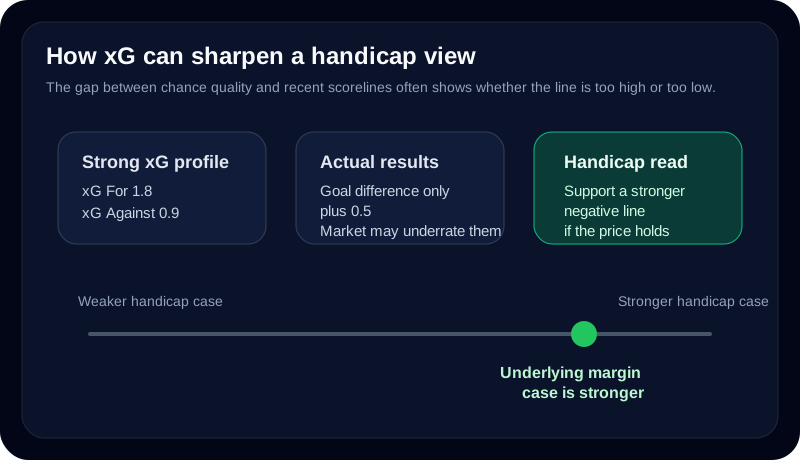 How xG can support or challenge the handicap line.
Why xG matters for handicap betting
xG helps bettors:
- Measure true attacking and defensive strength.
- Identify teams creating high-quality chances consistently.
- Spot defensive weakness hidden by results.
- Estimate expected goal margins more accurately.
This becomes especially important when recent scorelines are misleading.
Identifying value through xG discrepancies
Value often appears when there is a gap between:
- Underlying xG performance.
- Market perception based on recent results.
Common scenarios:
| Situation | Betting Implication |
|---|---|
| High xG and low goals scored | Potential undervaluation |
| Low xG and high goals scored | Overvaluation risk |
| Strong xG differential | Supports negative handicaps |
| Weak xG differential | Supports positive handicaps |
xG and margin projection
xG is particularly useful when estimating whether a team can cover a line.
Example:
- xG For at 2.0.
- xG Against at 0.8.
- Expected margin around +1.2.
That profile suggests the team is more likely to:
- Cover
-0.75consistently. - Compete well on
-1.0. - Occasionally justify
-1.25.
Limitations of xG
Despite its value, xG is not perfect.
Key limitations include:
- It does not fully capture finishing talent.
- It ignores some game-state effects.
- It can be distorted by small sample sizes.
- Different models produce slightly different values.
How to apply xG to the line
When evaluating a handicap:
- Compare xG differential with the line.
- Check whether results align with underlying performance.
- Identify regression candidates.
- Combine xG with injuries, tactics, and motivation.
What xG helps you see
- xG improves margin estimation, which is central to handicap betting.
- It helps identify teams mispriced because of recent results.
- Strong xG profiles can support more aggressive handicap positions.
- Weak or inflated xG signals usually call for caution.
Odds implied probability and line movement in Asian handicap markets
Asian handicap betting is not only about predicting margins. It is about judging whether the odds accurately reflect the true probability of that margin being covered.
Even when the match analysis is correct, a bet only becomes valuable when the price is in your favor.
Converting odds into implied probability
| Odds | Implied Probability |
|---|---|
| 1.50 | 66.7% |
| 1.80 | 55.6% |
| 2.00 | 50.0% |
| 2.20 | 45.5% |
This is the baseline that must be compared with your own estimate.
For example:
- If a
-0.75handicap is priced at1.95, the implied probability is about 51.3%. - If your model estimates 57%, there is a positive EV edge.
The role of the handicap and odds together
A common mistake is evaluating the handicap without the price.
| Handicap | Odds | True Evaluation |
|---|---|---|
| -0.5 | 1.60 | Possibly overpriced |
| -0.75 | 1.95 | Potential value |
| -1.0 | 2.20 | Higher risk with higher reward |
The line defines what must happen. The odds define whether it is worth betting.
Understanding line movement
Asian handicap markets move constantly based on:
- Betting volume.
- Sharp money.
- Injury or lineup news.
- Market corrections.
Types of line movement
| Movement Type | Example | Interpretation |
|---|---|---|
| Handicap shift | -0.75 to -1.0 | Increased confidence in favorite |
| Odds drop | 1.95 to 1.80 | Demand for that side |
| Odds drift | 1.80 to 2.00 | Reduced confidence |
| Reverse movement | Odds rise despite heavy betting | Sharp resistance |
These shifts can reveal where informed money is going, but they still need to be interpreted carefully.
Identifying value vs market efficiency
Key situations to monitor:
- Early value before the market corrects.
- Closing line value where your ticket beats the close.
- Overreactions based on news or public sentiment.
Consistently beating the closing line is often a strong sign that the process is aligned with long-term value.
How to judge the price
Before placing a bet, ask:
- What probability do the odds imply?
- What probability do you estimate?
- Is the gap meaningful?
- Has the line already moved and taken the value with it?
What line movement can tell you
- Odds determine value, not the handicap alone.
- Always convert the price into implied probability.
- Line movement can reveal information, but it is not automatically correct.
- Long-term success depends on pricing inefficiencies, not just picking winners.
Squad news motivation and scheduling pressure before you bet
This market is highly sensitive to short-term context changes.
Even if the baseline analysis is correct, injuries, fatigue, and motivation can shift the expected margin enough to invalidate the bet.
Key context variables that impact handicap outcomes
| Factor | Impact on Margin | Betting Relevance |
|---|---|---|
| Injuries to key players | Reduces attacking or defensive quality | Weakens favorites |
| Squad rotation | Lowers cohesion | Increases variance |
| Fixture congestion | Fatigue and slower tempo | Fewer dominant wins |
| Motivation and table position | Changes intensity | Affects consistency |
| Travel distance | Physical and mental fatigue | Hurts away teams |
These variables influence not just whether a team wins, but how convincingly it performs.
Injury impact is not equal across positions
Not all absences affect handicap outcomes equally.
- Missing attackers reduces the chance of covering negative handicaps.
- Missing defensive leaders raises the chance of conceding.
- Missing control players can affect tempo and dominance in more subtle ways.
A team can still win without key players while failing to win by the margin required.
Motivation and game-state behavior
Motivation is often mispriced because it is difficult to quantify.
| Scenario | Likely Impact |
|---|---|
| Title race or promotion push | Higher intensity and sustained pressure |
| Mid-table with low stakes | Lower urgency |
| Relegation battle | Tighter and more defensive games |
| European fixture ahead | Rotation risk |
These factors affect whether a team:
- Pushes for more goals.
- Protects a narrow lead.
- Accepts a draw.
Scheduling and fatigue effects
Fixture congestion is one of the most consistent sources of hidden value.
Key signs of fatigue:
- Reduced pressing intensity.
- Lower shot volume.
- Slower tempo.
- More defensive errors late.
Schedule pressure indicators:
- Three matches in seven to eight days.
- Long travel between fixtures.
- Rotation in the previous match.
- A high-priority match coming next.
These situations often lower the chance of multi-goal wins, even for strong favorites.
Common market mistakes
| Situation | Market Reaction | Reality |
|---|---|---|
| Big team rotates | Minimal adjustment | Margin drops significantly |
| Star player missing | Overreaction | Team structure may still be strong |
| Congested schedule | Ignored | Performance declines |
| Must-win narrative | Inflated odds | Pressure can reduce efficiency |
Markets are efficient overall, but context is often still under- or over-adjusted.
What to check late
Before placing a handicap bet:
- Are there injuries affecting goal production or prevention?
- Is rotation likely because of schedule pressure?
- Does motivation suggest aggression or caution?
- Is fatigue likely to reduce margin potential?
What context changes most
- Context can shift expected margins significantly.
- Not all absences have equal impact.
- Fatigue and scheduling often reduce dominance.
- Motivation changes whether teams keep pushing beyond a one-goal lead.
Building a safer Asian handicap framework
A consistent approach requires more than understanding the mechanics of the market. It needs a structured process that balances probability, price, and risk.
The aim is not to predict outcomes perfectly, but to make repeatable positive EV decisions while controlling variance.
Core framework components
| Component | Purpose | Impact on Decision |
|---|---|---|
| Margin estimation | Predict expected goal difference | Determines line suitability |
| Probability assessment | Estimate likelihood of covering | Defines edge |
| Odds evaluation | Compare market price with true probability | Identifies value |
| Context adjustment | Factor in injuries, fatigue, and motivation | Refines projections |
| Risk classification | Align bet type with volatility | Controls bankroll impact |
Each step builds on the previous one. Skipping any part reduces decision quality.
Step-by-step decision process
A disciplined process usually follows this structure:
- Estimate expected goal margin from xG, team strength, and form.
- Compare that estimate with the handicap line.
- Convert the odds into implied probability.
- Calculate the edge between your estimate and the market.
- Apply contextual filters such as injuries, fatigue, and motivation.
- Classify risk level before betting.
Risk-based bet classification
| Category | Typical Lines | Risk Level | Use Case |
|---|---|---|---|
| Low risk | +0.5 and +1.0 | Lower variance | Defensive teams and tight matches |
| Medium risk | -0.25 and -0.75 | Balanced | Moderate edge scenarios |
| High risk | -1.25 and above | High variance | Clear dominance expected |
This kind of classification helps ensure that stake sizing matches uncertainty.
Key decision filters
Before placing a bet, validate it against these criteria:
- Is expected margin aligned with the handicap?
- Is there a measurable edge versus implied probability?
- Do underlying metrics support the pick?
- Has context been fully accounted for?
- Does the risk level match the bankroll strategy?
If one of these fails, the bet is often better left alone.
Common mistakes to eliminate
| Mistake | Why It Is Problematic |
|---|---|
| Betting without price evaluation | No edge means long-term losses |
| Overvaluing recent results | Ignores underlying performance |
| Ignoring margin profiles | Leads to poor line selection |
| Chasing high odds | Adds variance without edge |
| Overexposure to favorites | Big teams are often inflated |
Removing these mistakes usually improves results more than adding complexity.
How to put the framework to work
- Focus on selectivity over volume.
- Track closing line value as a performance signal.
- Avoid forcing bets when the edge is unclear.
- Use staking that matches risk level.
- Review decisions based on process, not only results.
What a safer process looks like
- A structured framework improves consistency and reduces variance.
- Margin estimation and probability comparison are central.
- Risk classification helps align bets with uncertainty.
- Long-term success depends on discipline rather than prediction certainty.
Conclusion
Asian handicap football betting is fundamentally a margin-based evaluation problem. The market provides a structured estimate of team strength differences, but value exists when that estimate diverges from reality.
Several consistent principles run through the entire process:
- Outcomes matter less than how teams perform in terms of margins.
- Metrics such as xG and goal difference are more reliable than raw results.
- Odds must always be read as probability, not just price.
- Context such as injuries, fatigue, and motivation can shift expected outcomes sharply.
- A structured framework improves decision quality and reduces unnecessary risk.
There is no certainty in football betting. Even well-reasoned positions will fail in the short term. The objective is not to eliminate uncertainty, but to make better probabilistic decisions over time.