
Both Teams to Score Betting Strategy for Better Match Selection
A data-driven guide to building a both teams to score betting strategy using xG, odds value, tactical analysis, and risk management.
In this article
- What a both teams to score betting strategy actually means
- The numbers that matter most for BTTS
- Home and away splits that improve both teams to score picks
- Using xG and chance quality to sharpen BTTS picks
- Which tactical matchups create better BTTS value
- League context and match type that shape BTTS value
- Team news and rotation signals that shift BTTS probability
- How to compare odds and true probability for both teams to score bets
- Risk filters that make BTTS selection more selective
- Building a sustainable BTTS process over time
This market works best when both sides have a realistic chance of scoring at least once within 90 minutes.
Unlike match result betting, BTTS removes the need to pick a winner. That does not make it easier. The challenge shifts toward evaluating chance creation, defensive vulnerability, and match dynamics at the same time.
BTTS works best when both teams are structurally capable of scoring, not simply when a fixture has a recent history of goals.
This market sits inside a wider goals-and-pricing cluster, so it pairs naturally with over 2.5 goals betting strategy, value betting football, and the live football predictions today board. Those pages help you compare mutual-scoring setups with broader totals and price discipline.
Start here
Football Betting Strategy for Smarter Long Term Decisions
This guide sits inside a wider topic path. Read the core concept first if you want the parent framework before the deeper market detail.
Read the core conceptWhat a both teams to score betting strategy actually means
Backing BTTS well is not about chasing high-scoring teams blindly. It is about identifying mutual scoring conditions, where both sides genuinely contribute to the probability.
At its core, BTTS requires two independent events:
- Team A scores at least one goal.
- Team B scores at least one goal.
That means a strong attacking team facing a weak attacking side is often still not enough.
BTTS market basics
| Factor | Explanation | Betting Impact |
|---|---|---|
| Market type | Yes or No on both teams scoring | Binary outcome increases variance |
| Time frame | 90 minutes only | Late goals matter significantly |
| Dependency | Two teams must contribute | Requires balance, not dominance |
| Common odds range | 1.60 to 2.10 | Often efficiently priced |
The market is usually efficient in top leagues, so value tends to come from:
- Mispriced defensive strength.
- Overlooked attacking consistency.
Key conditions for BTTS viability
- Both teams average at least 1.2 goals scored per match.
- Both teams concede regularly at one goal or more per match.
- Neither team plays consistently low-tempo football.
- Match importance does not suppress attacking intent.
Important limitation
BTTS loses regularly because of:
- One-sided matches such as 3 to 0 or 4 to 0.
- Low-quality finishing.
- Tactical shutdown after one team scores.
This is why structured models often classify BTTS picks by probability tier rather than by confidence language.
The numbers that matter most for BTTS
Strong BTTS selection starts with filtering matches through consistent statistical benchmarks.
Raw goals alone are not enough. The focus should stay on repeatable indicators of scoring probability.
Core statistical indicators
| Metric | Strong BTTS Signal | Weak Signal |
|---|---|---|
| Goals scored | 1.3 or more per game | Under 1.0 |
| Goals conceded | 1.2 or more per game | Under 0.8 |
| BTTS rate | 60% or more | Under 45% |
| Shots on target | 4 or more per match | Under 3 |
| Big chances | 1.5 or more per match | Under 1 |
These metrics help identify teams that:
- Consistently create chances.
- Regularly allow chances.
Why these numbers matter
BTTS depends on consistency rather than spikes.
A team that wins 4 to 0 and then fails to score in the next two matches is unreliable. A team that scores one goal in six straight matches is often far more useful for this market.
Key data filters
- Use a minimum sample size of 8 to 10 matches.
- Ignore early-season volatility.
- Prioritize recent form over broad season averages.
What this looks like in practice
A match where both teams:
- Score in 6 of their last 8 games.
- Concede in 5 or more of those games.
is usually a stronger BTTS candidate than a match with one high-scoring team and one inconsistent side.
Home and away splits that improve both teams to score picks
Home and away performance needs to be separated if you want BTTS reads to become more accurate. Aggregate season stats often hide important differences in scoring and conceding behaviour.
Many teams show asymmetrical profiles:
- Strong attacking output at home.
- Limited goal threat away.
- Defensive instability only in specific environments.
Ignoring this often leads to inflated BTTS probabilities.
Home vs away performance indicators
| Metric | Home Team Ideal | Away Team Ideal | BTTS Impact |
|---|---|---|---|
| Goals scored | 1.5 or more | 1.2 or more | Both sides contribute |
| Goals conceded | 1.0 or more | 1.3 or more | Defensive vulnerability |
| BTTS rate | 65% or more | 60% or more | Strong historical signal |
| Shots on target | 5 or more | 4 or more | Sustained attacking pressure |
| Clean sheet rate | Under 30% | Under 25% | Reduces BTTS risk |
The key is not just whether teams score, but where they score consistently.
Why venue splits matter
Home teams tend to:
- Create more chances because of territorial advantage.
- Play with higher tempo and pressing intensity.
Away teams often:
- Concede more chances.
- Rely on transitions, which can still support BTTS if executed well.
This often creates a strong BTTS profile:
- Dominant home attack.
- Vulnerable away defence.
- Counter-attacking away threat.
Common BTTS-friendly scenarios
- The home team scores in more than 80% of home matches.
- The away team scores in at least 60% of away matches.
- Both teams concede in at least 70% of relevant fixtures.
These conditions suggest mutual scoring probability rather than one-sided dominance.
Warning signs to filter out
- Home team with a strong defence and low concession rate at home.
- Away team with a poor scoring record away from home.
- Teams with high clean sheet percentages in their respective roles.
These lower the chance of both teams contributing.
Practical application
When evaluating a fixture:
- Start with home scoring reliability.
- Confirm away scoring capability.
- Validate that both teams concede regularly in those specific contexts.
TipSignal next step
Use this on the live predictions board
See how these pricing and market ideas connect to TipSignal's live daily board before the shortlist gets narrowed.
Check today's football predictionsUsing xG and chance quality to sharpen BTTS picks
Moving from raw goals to expected goals and chance quality metrics is what makes this market much more reliable.
Goals are volatile. xG is more stable. It reflects the quality of chances created and conceded, which is far more predictive over time.
Why xG matters for BTTS
BTTS requires both teams to generate at least one meaningful scoring opportunity.
A team scoring from low-probability shots is difficult to trust. A team consistently producing strong xG values is much easier to rate as structurally reliable.
Key xG benchmarks for BTTS
| Metric | Strong BTTS Signal | Weak Signal | Interpretation |
|---|---|---|---|
| xG For | 1.4 or more | Under 1.0 | Consistent chance creation |
| xG Against | 1.2 or more | Under 0.9 | Defensive vulnerability |
| Combined xG | 2.8 or more | Under 2.2 | Open game profile |
| Big chances created | 2.0 or more | Under 1.2 | High scoring potential |
| Big chances conceded | 1.5 or more | Under 1.0 | Defensive exposure |
The strongest BTTS matches usually feature:
- Two teams above roughly 1.2 to 1.4 xG per game.
- Both sides conceding high-quality chances consistently.
xG versus actual goals
One of the most useful edges comes from a mismatch between xG and actual goals.
Example:
- Team A xG is 1.6 but goals scored are only 0.9.
- Team B xGA is 1.5 but goals conceded are only 0.8.
That often points to an underperforming attack against a defence that has been overperforming, which can create undervalued BTTS spots.
Practical xG filters for BTTS
- Both teams average at least 1.3 xG for.
- Both teams concede at least 1.1 xG against.
- Neither team consistently suppresses xG through very low tempo or deep defensive structure.
These filters reduce reliance on unsustainable finishing runs.
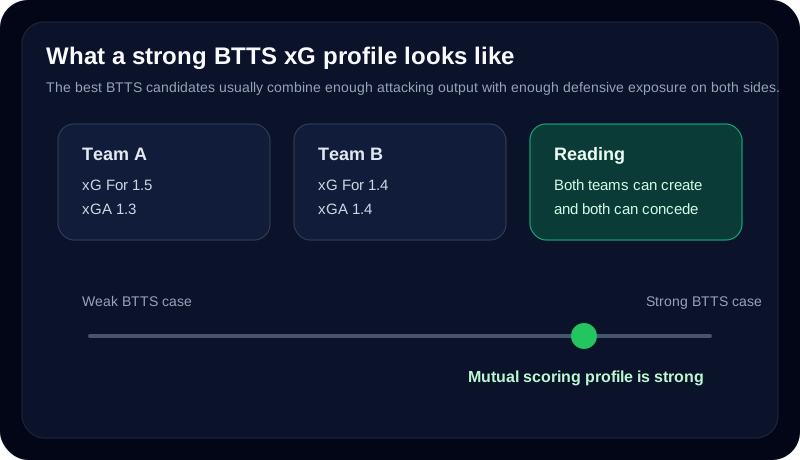 A BTTS xG profile showing two teams with enough attacking output and enough defensive exposure to support mutual scoring.
Common mistakes when using xG
- Relying on single-match xG instead of broader averages.
- Ignoring opponent strength in xG data.
- Overvaluing teams with high xG from poor shot locations.
Where xG becomes useful
The best BTTS setups usually appear when:
- Both teams are creating enough chances to score once.
- Both teams are allowing enough chances to concede once.
That dual condition is what separates structured analysis from surface-level reading.
Which tactical matchups create better BTTS value
Tactical dynamics matter because strong scoring numbers alone do not guarantee that both sides will find the right kind of chances.
Two teams may show strong scoring numbers, but if their styles cancel each other out the BTTS probability drops. On the other hand, certain tactical matchups naturally increase mutual scoring conditions.
Key tactical profiles that support BTTS
| Tactical Element | Team A Profile | Team B Profile | BTTS Impact |
|---|---|---|---|
| Defensive line | High line | Direct fast attack | Space in behind creates chances for both sides |
| Pressing style | Aggressive press | Press-resistant buildup | Transition opportunities |
| Full-back positioning | Advanced | Wide attackers | Exposure in wide channels |
| Build-up risk | Short passing | High press opponent | Forced errors create chances |
| Tempo | High | High | Shot volume rises |
The strongest BTTS matches often involve structural risk on both sides, not just attacking intent.
Tactical matchups that increase BTTS probability
- High defensive lines against teams with pace in attack.
- Two pressing teams that force turnovers in dangerous areas.
- Teams relying on attacking full-backs and leaving space behind.
- Midfields that prioritize progression over control.
These setups tend to produce:
- More transitions.
- More defensive errors.
- Higher shot frequency.
Tactical setups that reduce BTTS value
- Low block against low block.
- One dominant possession side against a passive defensive opponent.
- Teams that slow the game after scoring first.
- Sides with strong defensive structure and compact shape.
These matches often lead to one-sided scorelines or low-event games.
Key tactical filters for BTTS
When evaluating a match, look for:
- Space creation between the lines or behind the defence.
- Transition frequency and counter-attacking exposure.
- Press resistance on both sides.
- Defensive mistakes under pressure.
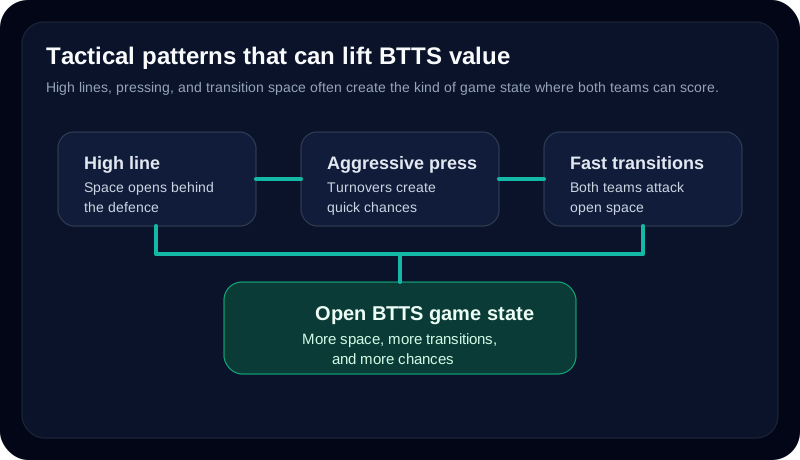 A BTTS tactical diagram showing how a high line, pressing, and transition space can create scoring chances for both teams.
What the tactical picture is telling you
The ideal BTTS match is not simply two attacking teams. It is two teams that create chances consistently while also allowing structural weaknesses to be exposed.
League context and match type that shape BTTS value
This market cannot be applied in exactly the same way across all leagues and competitions. Scoring patterns vary widely depending on league structure, playing style, and match incentives.
Ignoring context is one of the most common reasons BTTS bets underperform.
League-level BTTS tendencies
| League Type | Typical Style | BTTS Frequency | Betting Impact |
|---|---|---|---|
| High-tempo leagues | Open and transition-heavy | High at 60 to 65% | More BTTS opportunities |
| Tactical leagues | Structured and defensive | Medium at 50 to 55% | Selective approach needed |
| Defensive leagues | Low tempo and compact | Low at 45 to 50% | BTTS often overpriced |
| Lower divisions | Unpredictable and error-prone | High variance | Value but higher risk |
Leagues differ in:
- Pressing intensity.
- Defensive organization.
- Refereeing tendencies.
- Overall tempo.
These factors all influence whether both teams are likely to score.
Match type and motivation
| Match Type | Typical Behaviour | BTTS Impact |
|---|---|---|
| Regular league match | Balanced approach | Neutral baseline |
| Relegation battle | Open and high tension | Often positive for BTTS |
| Title race match | Controlled and cautious | Often reduces BTTS |
| Cup knockout first leg | Conservative | Lower BTTS probability |
| Cup knockout second leg | Game-state dependent | Can increase BTTS late |
| Dead rubber | Low intensity or open | Unpredictable |
Motivation shapes:
- Risk-taking.
- Defensive structure.
- Attacking commitment.
Key contextual filters
- Avoid early knockout ties with low-risk approaches.
- Be cautious with top-tier clashes where teams prioritize not losing.
- Look for matches where both teams need points.
Indicators of BTTS-friendly context
- Mid-table clashes with low pressure.
- Teams fighting relegation and losing defensive discipline.
- Leagues with historically high goal averages.
- Fixtures where both teams benefit from attacking outcomes.
Warning signals
- Teams satisfied with a draw.
- Large quality gaps.
- Competitions where defensive structure is heavily prioritized.
These reduce mutual scoring probability.
How context changes the read
A strong BTTS strategy adjusts expectations using league baseline scoring levels and the specific incentives of the match in front of you.
Team news and rotation signals that shift BTTS probability
Team news can change a BTTS read quickly. Injuries, suspensions, and rotation decisions often shift scoring probability more than the market first reflects.
Unlike broad form data, team news is time-sensitive and asymmetric, which means one key absence can reshape the BTTS value.
Key squad factors that influence BTTS
| Factor | Impact on Team | BTTS Effect |
|---|---|---|
| Missing centre-backs | Defensive instability | Increases BTTS probability |
| Goalkeeper absence | Lower shot-stopping quality | Increases BTTS probability |
| Missing main striker | Reduced finishing ability | Decreases BTTS probability |
| Rotated defence | Lack of cohesion | Increases BTTS probability |
| Midfield absences | Less control and more transitions | Often increases BTTS |
Not all absences are equal. Defensive disruptions tend to increase BTTS probability more consistently than attacking absences reduce it.
High-impact BTTS team news signals
- First-choice centre-back pairing unavailable.
- Backup goalkeeper starting.
- Full-backs missing.
- High turnover caused by congestion.
- Heavy rotation in cup competitions.
These situations often lead to:
- More defensive errors.
- Weaker structure.
- Better chances conceded.
When team news reduces BTTS value
- Key striker or primary goal scorer missing.
- Creative midfielders unavailable.
- Teams shifting to conservative systems because of absences.
- Managers prioritizing defensive stability.
These reduce the chance that both teams contribute.
Rotation patterns and scheduling
Fixture congestion plays a major role:
- Teams in European competition often rotate league lineups.
- Lower-depth squads struggle more with repeated matches.
- Rotated teams may defend worse but also attack less efficiently.
This creates mixed BTTS signals and needs careful interpretation.
Practical checklist before betting
- Are both teams close to full attacking strength?
- Is either defence weakened or rotated?
- Is there a goalkeeper change?
- Is fatigue likely to reduce defensive intensity?
What to check late
Team news is one of the few places where short-lived inefficiencies still appear in BTTS markets.
How to compare odds and true probability for both teams to score bets
Profit only starts to appear when you move beyond identifying likely outcomes and start asking whether the odds still offer value.
BTTS is frequently well priced by bookmakers. Without comparing implied probability and estimated probability, even accurate reads can become long-term losing bets.
Converting odds to implied probability
| Odds Decimal | Implied Probability | Interpretation |
|---|---|---|
| 1.50 | 66.7% | Very high expectation of BTTS |
| 1.70 | 58.8% | Strong probability |
| 1.90 | 52.6% | Balanced market |
| 2.10 | 47.6% | Slightly unlikely |
| 2.40 | 41.7% | Underdog BTTS scenario |
This conversion helps answer a key question. Does the market expectation match the real chance of both teams scoring?
Estimating true probability
A structured estimate should combine:
- Attacking consistency through goals and xG.
- Defensive vulnerability through goals conceded and xGA.
- Tactical openness.
- Team news impact.
Example breakdown
| Factor | Team A | Team B | Combined Impact |
|---|---|---|---|
| Goals scored | 1.6 | 1.4 | Positive |
| Goals conceded | 1.3 | 1.5 | Positive |
| xG For | 1.5 | 1.3 | Positive |
| xGA | 1.4 | 1.6 | Positive |
| Tactical style | High tempo | Transition-based | Supports BTTS |
Estimated BTTS probability at roughly 62 to 65 percent would make odds of 1.90 look attractive because the market implies only 52.6 percent.
Identifying value versus no value
| Scenario | Market Probability | Estimated Probability | Decision |
|---|---|---|---|
| Aligned | 58% | 57% | No edge |
| Undervalued BTTS | 52% | 62% | Value bet |
| Overvalued BTTS | 65% | 55% | Avoid |
The goal is not just to predict outcomes. It is to identify pricing inefficiencies.
Key value indicators
- Teams with strong xG but low recent goals.
- Defensive overperformance despite high xGA.
- Misleading recent clean sheets against weak opponents.
These situations often produce bigger BTTS prices than they should.
Common mistakes
- Backing BTTS at low odds without a clear edge.
- Ignoring bookmaker margin.
- Overreacting to short-term form instead of underlying data.
What to remember about price
A disciplined BTTS strategy treats odds as a probability statement that needs to be challenged, not accepted.
Risk filters that make BTTS selection more selective
Selection improves when the process focuses not only on identifying good matches, but also on eliminating poor ones.
Many long-term BTTS losses come from:
- Over-selection.
- Marginal edges.
- Ignoring structural risks.
Selective filtering is what separates disciplined strategies from random picking.
Core risk filters for BTTS selection
| Risk Factor | Warning Signal | BTTS Impact |
|---|---|---|
| One-sided matchups | Strong favorite against weak attack | Low probability of both scoring |
| Low xG teams | Both teams under 1.1 xG | Limited chance creation |
| High clean sheet rates | 40% or more | Defensive stability reduces BTTS |
| Slow tempo teams | Low shot volume | Fewer scoring opportunities |
| Game control styles | Possession-heavy and risk-averse | Suppresses opponent chances |
These filters remove matches where both teams are unlikely to contribute equally.
High-risk BTTS scenarios to avoid
- Top-tier defensive teams against low-scoring sides.
- Matches with large quality gaps.
- Fixtures where one team averages under 0.9 goals per match.
- Teams that consistently win to nil.
These often produce one-sided scorelines or low-event matches.
Red flags before placing a BTTS bet
- One team relies heavily on set pieces and offers little open-play threat.
- The opponent rarely concedes high-quality chances.
- Recent BTTS results were driven by unsustainable finishing.
- Weather or pitch conditions are likely to reduce tempo.
Structured match selection checklist
Before confirming a BTTS pick:
- Do both teams have consistent scoring patterns?
- Do both teams concede regularly?
- Is the tactical setup likely to produce open play?
- Is there any clear mismatch in quality or motivation?
If two or more answers are negative, the match is usually better avoided.
Balancing selectivity and volume
A common mistake is trying to bet too many BTTS opportunities.
A more structured approach:
- Focuses on higher-probability setups.
- Accepts fewer bets with clearer edges.
- Avoids forcing selections on weak slates.
What strong filtering really does
A strong BTTS strategy is defined as much by what it avoids as by what it selects.
Building a sustainable BTTS process over time
This approach is only useful if it performs consistently across a large sample of bets. Short-term results are volatile, so sustainability depends on process quality rather than outcomes.
The aim is to build a framework that:
- Identifies value.
- Controls variance.
- Maintains discipline.
Core components of a sustainable strategy
| Component | Description | Long-Term Impact |
|---|---|---|
| Match selection | Strict filtering criteria | Reduces low-quality bets |
| Probability estimation | Data plus tactical reasoning | Improves decision accuracy |
| Odds comparison | Identifying value gaps | Drives profitability potential |
| Stake sizing | Controlled exposure per bet | Protects bankroll |
| Record tracking | Logging bets and outcomes | Enables performance analysis |
Without all five elements, even strong analysis becomes inconsistent over time.
Recommended structural approach
A sustainable BTTS strategy usually includes:
- Defined entry criteria.
- Context filters for league, motivation, and team news.
- A probability estimation model, even if simplified.
- Clear rejection rules.
This makes decisions:
- Repeatable.
- Measurable.
- Less influenced by short-term variance.
Example bet classification framework
| Category | Criteria | Typical Odds | Risk Profile |
|---|---|---|---|
| High probability | Strong stats and strong context | 1.50 to 1.70 | Lower variance |
| Value BTTS | Slightly mispriced markets | 1.70 to 2.10 | Moderate risk |
| High odds | Thin edge and higher uncertainty | 2.10 or more | High variance |
This kind of structure helps keep probability and risk separate instead of treating every BTTS bet the same way.
Bankroll and variance management
Even strong BTTS setups fail regularly. A realistic expectation:
- BTTS strategies often operate in 55 to 65 percent success ranges.
- Losing streaks of 4 to 6 bets are statistically normal.
Key principles:
- Flat staking at around 1 to 2 percent per bet.
- No stake increases after losses.
- No clustering too many bets in one round.
Tracking and continuous improvement
A sustainable strategy needs feedback.
Track:
- League performance.
- Odds ranges.
- Bet categories.
- Closing line movement.
This helps you identify:
- Where the edge exists.
- Where assumptions are wrong.
Common long-term mistakes
- Overconfidence after short winning runs.
- Expanding criteria just to increase volume.
- Ignoring closing odds as a benchmark.
- Failing to adapt to league-specific trends.
These issues usually erode any early edge.
What a durable process looks like
A disciplined BTTS strategy is not defined by how many bets you place or how often you win in the short term. It is defined by consistent decision quality, accurate probability assessment, and strict risk control.
Conclusion
A well-constructed both teams to score betting strategy relies on combining several layers of analysis rather than focusing on goals alone.
The most reliable setups usually appear when:
- Both teams consistently create chances.
- Both teams show defensive vulnerability.
- Tactical and contextual factors support open play.
Identifying likely outcomes is only part of the process. The real edge comes from:
- Comparing probabilities with market odds.
- Filtering out structurally weak matches.
- Maintaining disciplined staking and selection.
BTTS betting carries natural variance, and no strategy removes that uncertainty. What it can do is reduce avoidable errors and improve decision quality over time.