
Over 2.5 Goals Betting Strategy for Better Match Selection
A complete over 2.5 goals betting strategy guide with data-driven analysis, probability tips, and risk management insights for smarter football betting.
In this article
- How the over 2.5 goals market really works
- The match filters that matter most
- Why goal trends matter in over 2.5 betting
- Using xG and chance quality to improve over 2.5 picks
- Which home and away patterns are worth trusting
- Tactical setups that support over 2.5 goals bets
- League scoring patterns and where value shows up
- How to compare bookmaker odds with true goal probability
- Risk management rules that keep the strategy usable
- The biggest mistakes in over 2.5 betting
Most bettors lose money in the over 2.5 goals market for one simple reason. They bet on what happened last week instead of what is mathematically likely to happen today.
Backing a match just because one team played in a 3 to 2 thriller last time out is one of the fastest ways to drain a bankroll. The real edge comes from identifying games where the true probability of goals is higher than the bookmaker's price.
At a basic level, you are betting on a match producing three or more goals. The useful part is not the market itself. It is knowing when the price is lagging behind chance quality, tempo, and matchup dynamics.
Most losing bettors focus on recent scorelines. Better processes focus on chance creation, tempo, and matchup dynamics first.
If you want to compare this market with a slightly different goals angle, read both teams to score betting strategy alongside this guide. To judge whether the price is actually worth taking, it also helps to pair totals betting with value betting football and the live football predictions today board.
Start here
Football Betting Strategy for Smarter Long Term Decisions
This guide sits inside a wider topic path. Read the core concept first if you want the parent framework before the deeper market detail.
Read the core conceptHow the over 2.5 goals market really works
The over 2.5 goals market is simple in outcome but much harder in interpretation. To use it well, you need to understand both settlement and probability.
At settlement level, the rule is binary:
| Total Goals in Match | Bet Outcome |
|---|---|
| 0 to 2 goals | Loss |
| 3 or more goals | Win |
However, betting value is not about outcomes alone. It is about price versus probability.
For example:
| Odds | Implied Probability |
|---|---|
| 1.50 | 66.7% |
| 1.70 | 58.8% |
| 2.00 | 50.0% |
If your analysis suggests a match has a 62 percent chance of going over 2.5:
- Odds of 1.70 could represent value.
- Odds of 1.50 are likely too short.
What matters most
- Over 2.5 is still high variance even when it looks frequent.
- Bookmakers adjust this market heavily based on public perception.
- Not all attacking teams create high total-goal games because game control matters.
- Value exists when market perception lags behind underlying data.
From a structured perspective, this is why models often separate these matches into:
- High-probability but short-priced overs.
- Balanced value spots.
- Higher-risk overs driven mainly by price.
Understanding that distinction is the foundation of a sustainable over 2.5 goals strategy.
The match filters that matter most
A profitable over 2.5 goals strategy usually starts with eliminating unsuitable matches, not selecting attractive ones. Most fixtures in any round are poor candidates for high goal totals.
The aim is to find matches where several independent factors point toward a high-scoring environment.
Core match selection filters
The following filters form a useful baseline:
- Teams averaging 1.4 or more goals scored per match.
- Teams conceding 1.2 or more goals per match.
- A combined over 2.5 hit rate above 55 to 60 percent.
- Both teams averaging at least 10 total shots per game.
- At least one team playing with high tempo or direct transitions.
These filters are not predictive on their own, but they remove a lot of low-probability noise.
Example filtering framework
| Criteria | Team A | Team B | Combined Signal |
|---|---|---|---|
| Average goals scored | 1.6 | 1.5 | Strong |
| Average goals conceded | 1.3 | 1.4 | Strong |
| Over 2.5 hit rate | 62% | 58% | Positive |
| Shots per match | 13.2 | 11.8 | Strong |
| Clean sheet rate | Low | Low | Supports over |
When multiple indicators align like this, a match moves into a candidate pool rather than becoming an automatic bet.
High-value filtering signals
Certain patterns consistently correlate with over 2.5 outcomes:
| Signal Type | Why It Matters |
|---|---|
| Both teams score often | Raises baseline goal probability |
| Weak defensive structure | Leads to repeated chance concessions |
| High pressing intensity | Creates transition chances |
| Low clean sheet frequency | Reduces the chance of a low total |
What to look for
- Filtering is about stacking probability, not chasing certainty.
- Avoid matches where only one team contributes to goals.
- Defensive consistency is often more important than attacking form.
- Popular teams are often overpriced in goals markets.
TipSignal next step
Use this on the live predictions board
See how these pricing and market ideas connect to TipSignal's live daily board before the shortlist gets narrowed.
Check today's football predictionsWhy goal trends matter in over 2.5 betting
Goal trends are one of the most visible indicators in any over 2.5 strategy, but they are often misused. The key is not just spotting high-scoring teams. It is understanding whether those trends look sustainable.
Raw scorelines can be misleading. A team that recently played several 3 to 2 matches may look ideal, but without consistent chance creation that pattern often regresses.
Core goal trend metrics to track
| Metric | Team A | Team B | Interpretation |
|---|---|---|---|
| Average goals scored | 1.8 | 1.6 | Strong attacking output |
| Average goals conceded | 1.4 | 1.5 | Defensive vulnerability |
| Over 2.5 hit rate | 65% | 60% | Positive trend alignment |
| Both teams scored rate | 68% | 64% | High mutual scoring chance |
| Clean sheet rate | 18% | 22% | Low defensive stability |
When several goal-related metrics line up, the chance of a high-scoring match increases. It still needs context.
Short-term and long-term trends
One of the biggest edges comes from judging sample-size reliability correctly:
| Sample Type | Reliability | Betting Impact |
|---|---|---|
| Last 3 matches | Low | Often noisy |
| Last 5 to 8 matches | Medium | Needs context |
| Season-long data | High | More stable |
Short-term spikes often come from:
- Red cards.
- Penalty-heavy matches.
- Unusual finishing efficiency.
Those patterns are rarely sustainable.
How to read the signal
- Consistent BTTS and over 2.5 overlap is a strong signal.
- High scoring without strong chance volume is a warning sign.
- Teams with volatile scorelines often regress toward normal ranges.
- Defensive conceding patterns are often more predictive than scoring form.
Red flags in goal trend analysis
- Overreliance on recent results without underlying data.
- Ignoring the quality of opposition.
- Treating outlier matches as stable patterns.
- Backing overs where one team dominates but controls the tempo.
Goal trends are most useful as a confirmation layer, not the whole strategy.
Using xG and chance quality to improve over 2.5 picks
Expected goals is one of the most reliable tools in an over 2.5 strategy because it measures chance quality, not just scorelines. It helps separate sustainable scoring patterns from short-term variance.
A match finishing 1 to 1 can still be a strong over candidate if the underlying data shows high chance volume and quality.
Core xG indicators to analyze
| Metric | Team A | Team B | Combined Insight |
|---|---|---|---|
| xG For | 1.75 | 1.60 | Strong attacking output |
| xG Against | 1.40 | 1.55 | Defensive vulnerability |
| Combined total xG | 3.15 | — | Supports over expectation |
| Big chances per game | 2.4 | 2.1 | High-quality opportunities |
| Shots in the box | 9.2 | 8.7 | Consistent scoring positions |
As a general guide:
- Combined xG above 2.8 to 3.0 supports over 2.5.
- Consistent big chance creation improves reliability.
- High xG conceded is often more predictive than xG created.
Why xG outperforms raw goal data
Traditional stats can mislead because finishing varies wildly:
| Scenario | Goals | xG | Interpretation |
|---|---|---|---|
| Clinical finishing | 3 | 1.5 | Likely downward regression |
| Poor finishing | 1 | 2.6 | Likely increase in future goals |
| Balanced performance | 2 | 2.1 | Stable expectation |
This is why relying only on results often leads to chasing a trend too late.
Key advantages of using xG
- It identifies matches where goals are likely but not yet realized.
- It filters out teams overperforming through unsustainable finishing.
- It highlights defensive weaknesses hidden by scorelines.
- It can improve timing before the market fully reacts.
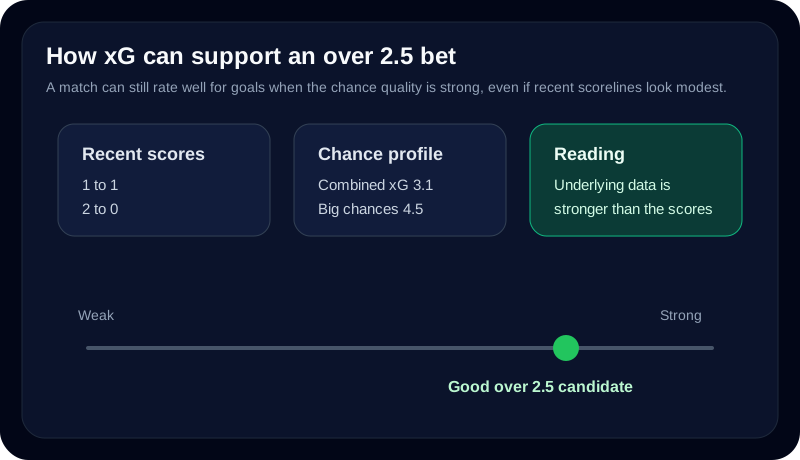 A simple xG comparison chart showing how strong chance volume can support an over 2.5 bet even when recent scorelines look modest.
Practical decision criteria
To use xG well, look for:
- Combined xG consistently above 2.7 in recent matches.
- Both teams generating at least 1.2 xG per game.
- At least one team conceding 1.4 xG or more on a regular basis.
- Matches where xG trends are rising rather than fading.
Common xG mistakes
- Treating xG as an exact forecast instead of a probability signal.
- Ignoring style and tempo.
- Overvaluing one-off xG spikes.
- Failing to adjust for opponent strength.
This is usually where good goals analysis starts to become much more reliable.
Which home and away patterns are worth trusting
Home and away splits are often overlooked in over 2.5 betting, yet they frequently explain why strong-looking matches fail to produce goals.
Teams rarely behave the same way in different environments. Some are aggressive at home but conservative away, while others rely more on counter-attacks when travelling.
Key home and away indicators
| Metric | Team A Home | Team B Away | Interpretation |
|---|---|---|---|
| Average goals scored | 1.9 | 1.3 | Strong home attacking bias |
| Average goals conceded | 1.2 | 1.6 | Away defensive vulnerability |
| Over 2.5 hit rate | 68% | 62% | Positive alignment |
| BTTS rate | 65% | 67% | Mutual scoring likelihood |
| Clean sheet rate | 20% | 18% | Low defensive stability |
This kind of split often creates ideal over conditions, especially when:
- The home side pushes aggressively.
- The away side is defensively weak but still capable of scoring.
Common home and away patterns that support overs
- Strong home scorers against weak away defences.
- Away teams with high BTTS rates.
- Teams that concede early on the road.
- Home sides with high pressing intensity.
Patterns that look strong but mislead
| Misleading Pattern | Risk Explanation |
|---|---|
| Strong home defence | Can suppress total goals |
| Away teams that sit deep | Reduce tempo |
| One-sided attacking dominance | Can lead to controlled, low-variance games |
| Low BTTS away teams | Limit the total-goal ceiling |
A team winning 2 to 0 regularly at home may still be a poor over 2.5 side if it controls matches instead of opening them up.
What matters in the split
- Focus on how the two styles interact, not isolated numbers.
- Overs are stronger when both teams can contribute to scoring.
- Away defensive weakness often matters more than raw home attack.
- Clean sheet frequency is a strong filter.
Tactical setups that support over 2.5 goals bets
Tactics are one of the most decisive and often underestimated parts of any over 2.5 strategy. Statistics tell you what happened. Tactical structure tells you why it might happen again.
Certain matchups repeatedly create high-scoring games because they generate repeated high-quality situations, not just isolated chances.
Tactical profiles that favour high goal totals
| Tactical Element | Impact on Goals |
|---|---|
| High defensive line | Space behind the defence creates big chances |
| High pressing intensity | Turnovers happen in dangerous areas |
| Fast transition play | Shot frequency rises |
| Full-back overlap | More crosses and box entries |
| Low defensive compactness | xG conceded increases |
When both teams share even two or three of these traits, matches often become open and unstable.
High-probability tactical matchups
Some combinations are particularly strong:
- Pressing sides against teams weak in build-up.
- Two transition-focused teams.
- Wide attacking systems against shaky defensive shape.
- Aggressive full-backs on both sides stretching the back line.
These matchups increase the likelihood of multiple scoring phases rather than one dominant spell.
Tactical warning signs for unders
| Tactical Setup | Risk for Over 2.5 |
|---|---|
| Deep defensive block | Limits space and shot quality |
| Slow positional build-up | Reduces match pace |
| One team controlling possession | Lowers game volatility |
| Defensive midfield overload | Blocks central chances |
These setups often produce controlled games with fewer transitions and therefore fewer goals.
Game-state dynamics and tactical shifts
Another key factor is how teams react to in-game situations:
- Teams that keep attacking after scoring help overs.
- Teams that defend leads conservatively suppress totals.
- A higher chance of an early goal can boost the market considerably.
- Tactical flexibility can change tempo in the second half.
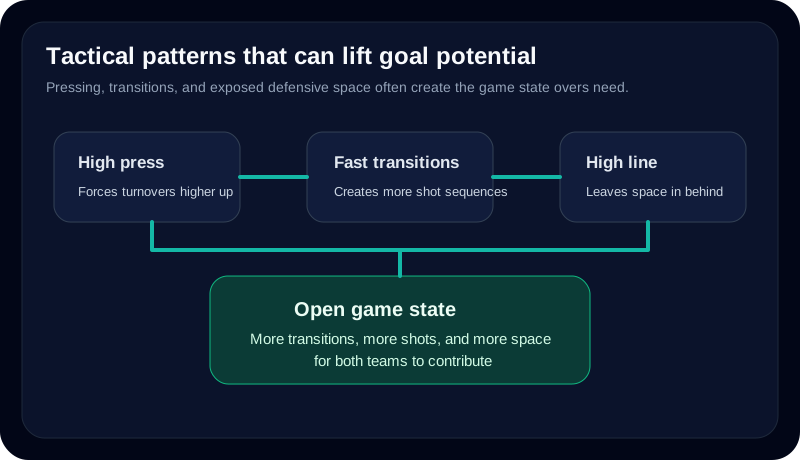 A tactical matchup diagram showing how pressing, transitions, and high defensive lines can combine to create a better over 2.5 setup.
What the matchup is telling you
- Tactical compatibility matters more than individual team strength.
- Overs are strongest in unstable, transition-heavy matches.
- Slow-tempo control games are often poor over spots.
- Look for teams that both create and allow chaos.
League scoring patterns and where value shows up
Not all leagues behave the same way when it comes to goals. A strong over 2.5 strategy should account for league-level tendencies because tempo, tactics, and defensive organisation vary widely.
Ignoring league context often leads to overestimating probabilities in low-scoring environments or missing value in leagues that are consistently more open.
Average goal output by league type
| League Profile | Average Goals per Game | Over 2.5 Rate | Betting Interpretation |
|---|---|---|---|
| High-tempo leagues | 2.9 to 3.2 | 60 to 65% | Strong over environment |
| Balanced leagues | 2.5 to 2.7 | 48 to 55% | Needs selective filtering |
| Defensive leagues | 2.2 to 2.4 | 40 to 48% | Overs less reliable |
This gives a useful starting point before looking at the match itself.
Key league characteristics that influence overs
- Pace of play.
- Defensive discipline.
- Refereeing style.
- Tactical culture.
Leagues with high pressing and direct play often produce more chaotic matches, which usually helps goal totals.
League-specific over 2.5 indicators
| Indicator | High-Scoring Leagues | Low-Scoring Leagues |
|---|---|---|
| BTTS frequency | High | Moderate or low |
| Clean sheet percentage | Low | Higher |
| Shot volume per match | High | Moderate |
| Transition frequency | High | Lower |
These differences are structural rather than temporary.
Where bettors often misjudge league impact
- Applying the same filters across every league.
- Overvaluing strong teams in defensive competitions.
- Ignoring travel, scheduling, and congestion.
- Misreading the influence of promoted and relegated sides.
A match can look strong on team data and still underperform if the league itself suppresses goals.
How to use league context
- Always adjust expectations using the league baseline.
- High-scoring leagues often come with shorter prices and less value.
- Mid-tier leagues with inconsistent defending often create better prices.
- League data works best when combined with team-level metrics.
How to compare bookmaker odds with true goal probability
A successful over 2.5 strategy depends on identifying value, not just likely outcomes. That means comparing the bookmaker's implied probability with your own estimate based on data.
Without that step, even accurate predictions can become long-term losing bets.
Converting odds into implied probability
Every set of odds contains a hidden probability:
| Odds | Implied Probability |
|---|---|
| 1.50 | 66.7% |
| 1.65 | 60.6% |
| 1.80 | 55.6% |
| 2.00 | 50.0% |
This is the bookmaker's estimate including margin. Your task is to decide whether the true probability is higher or lower.
Example of value identification
| Factor | Assessment |
|---|---|
| Model-estimated probability | 62% |
| Bookmaker implied probability | 55.6% |
| Difference | +6.4% |
| Value signal | Positive |
If your analysis suggests a higher probability than the market, the bet may offer positive expected value.
Core inputs for estimating true probability
To form a realistic probability, combine:
- xG data.
- Goal trends.
- Tactical matchup.
- Home and away splits.
- League scoring baseline.
No single metric is enough on its own.
Value and probability are not the same thing
| Scenario | Probability | Odds | Decision Logic |
|---|---|---|---|
| High probability, low odds | 70% | 1.40 | Often no value |
| Medium probability, fair odds | 58% | 1.80 | Potential value |
| Lower probability, higher odds | 45% | 2.40 | Higher variance decision |
Many bettors prioritize likelihood over price, which is why they end up overpaying for obvious-looking outcomes.
What to remember about price
- Value exists when your probability is higher than the implied probability.
- Bookmakers adjust quickly to public over trends.
- Not every strong over 2.5 match is a good bet.
- Small edges in the 3 to 5 percent range still matter over time.
Common pricing mistakes
- Betting overs in popular matches where odds are suppressed.
- Ignoring bookmaker margin.
- Overestimating probability from recent scorelines alone.
- Chasing larger odds without enough probability support.
Structured goal betting usually works best when match quality and price quality line up together.
Risk management rules that keep the strategy usable
Even the most refined over 2.5 strategy will fail without proper risk management. This market naturally includes variance, and strong underlying data does not stop matches from finishing under.
The goal is not to eliminate losses. It is to make sure losses stay controlled and proportionate.
Core bankroll management framework
| Bankroll Strategy | Stake per Bet | Risk Level | Suitability |
|---|---|---|---|
| Flat staking | 1 to 2% | Low | Most consistent approach |
| Variable staking | 1 to 3% | Medium | Needs discipline |
| Aggressive staking | 3 to 5% | High | High volatility and risky |
Flat staking is usually the most sustainable because it protects against the kind of downswings that are common in goal markets.
Variance in over 2.5 betting
Even strong edges lose frequently:
| True Probability | Expected Loss Rate |
|---|---|
| 60% | 40% losses |
| 58% | 42% losses |
| 55% | 45% losses |
This means losing streaks are normal, not proof that a strategy is broken.
Key risk management rules
- Limit each bet to 1 to 2 percent of total bankroll.
- Avoid increasing stakes after losses.
- Track results over large sample sizes.
- Accept that short-term outcomes do not reflect long-term edge.
- Prioritize consistency over emotional reaction.
Risk classification of over 2.5 bets
| Category | Description | Risk Profile |
|---|---|---|
| High-probability overs | Strong stats and low odds | Lower variance |
| Balanced value overs | Solid probability plus fair odds | Moderate risk |
| High-odds overs | Price-driven and less stable | Higher variance |
This helps bettors avoid overexposure to volatile selections even when they look attractive.
Common bankroll mistakes
- Overstaking on matches that feel strong.
- Increasing stake size after a winning streak.
- Ignoring variance and expecting steady wins.
- Betting too many matches at once.
- Mixing incompatible strategies without structure.
What keeps the strategy stable
- Long-term success comes from risk control, not prediction accuracy alone.
- Small edges need large sample sizes to show up.
- Emotional decisions are one of the main causes of bankroll decline.
- Stake consistency matters more than pick frequency.
The biggest mistakes in over 2.5 betting
Even with a structured over 2.5 strategy, many bettors lose because of systematic errors rather than bad luck. These mistakes usually come from misreading data, overreacting to trends, or ignoring price.
Understanding these pitfalls is essential if the strategy is going to stay disciplined over time.
Most common mistakes and their impact
| Mistake | Why It Happens | Betting Impact |
|---|---|---|
| Overvaluing recent scorelines | Recency bias | Inflated probability estimates |
| Ignoring xG data | Too much focus on results | Misleading conclusions |
| Backing big teams blindly | Public perception | Poor odds value |
| Skipping price comparison | Outcome-focused thinking | Negative expected value |
| Overlooking tactics | Lack of context | Misreading match dynamics |
These mistakes are common across most losing goals-betting patterns.
High-risk behavioural errors
- Chasing losses after unsuccessful bets.
- Increasing stakes based on confidence instead of probability.
- Betting too many matches without proper filtering.
- Ignoring long-term performance tracking.
- Switching strategies after short-term losing spells.
These behaviours are often more damaging than the original prediction errors.
Misleading signals in over 2.5 betting
| Signal | Why It Misleads |
|---|---|
| High-scoring last match | Often an outlier |
| Strong attacking team | May still control games instead of opening them up |
| Head-to-head history | Often irrelevant to the current match |
| League reputation | Can already be fully priced into the odds |
Many bettors rely on these shortcuts instead of proper multi-factor analysis.
Structural analysis mistakes
- Treating all leagues equally.
- Ignoring home and away differences.
- Using very small samples.
- Not adjusting for opponent strength.
- Overlooking defensive metrics.
How to avoid the usual traps
- Focus on process quality, not short-term outcomes.
- Combine multiple data points such as xG, trends, and tactics.
- Always compare probability with price.
- Accept that losses are part of the model.
- Stay consistent in both analysis and staking.
Conclusion
An over 2.5 goals strategy works best when it is approached as a probability-driven process rather than a pattern-based shortcut.
The strongest edge usually comes from combining:
- xG and chance quality.
- Goal trends and defensive data.
- Tactical matchup and league context.
- Odds versus true probability.
No single factor is enough on its own. The strength of the strategy comes from alignment across multiple indicators.
Variance matters just as much as selection. Even well-chosen bets lose regularly, which is why risk management and disciplined staking remain essential to long-term sustainability.
A structured process does not try to predict every match perfectly. It aims to make better decisions more consistently when price and probability are aligned.